
Cervical Cancer: Screening and Vaccination—The Best Prevention!
Cervical cancer causes 1,100 deaths each year. However, regular screening can prevent 90 percent of these cancers from developing.
Published on
Changed on

Cervical cancer causes 1,100 deaths each year. However, regular screening can prevent 90% of these cancers. Vaccination is an effective weapon against the main HPV (human papillomavirus) strains responsible for cervical cancer. The 17th European Cervical Cancer Prevention Week, January 23–30, 2023, is an opportunity to remind all women of the importance of this dual protection.
Each year, 3,000 new cases of cervical cancer are diagnosed in France. However, the World Health Organization notes that the disease could be completely eradicated by 2030 through screening and vaccination.

Vaccination Against High-Risk Oncogenic Human Papillomavirus
The main cause of cervical cancer is persistent infection with high-risk types of human papillomavirus (HPV), a family of very common viruses that are transmitted primarily through sexual contact. Condoms do not provide complete protection against them. Some of these, known as high-risk oncogenic types (HPV 16 and 18), can lead to the development of precancerous lesions that may progress to cervical and oropharyngeal cancers.
Vaccination against HPV is recommended by the French National Authority for Health (HAS) for all adolescents—boys and girls—aged 11 to 14. Catch-up vaccination may also be offered up to and including age 19.
However, it does not protect against all types of HPV and does not replace the need for regular screening.
Early Detection of Precancerous Lesions
Since 2018, a national organized screening program has recommended a Pap smear—covered by health insurance—for all women aged 25 to 65. Even after menopause, it is important to continue having this test performed by a gynecologist, primary care physician, or midwife.
The Pap smear is then analyzed in a laboratory using two different methods depending on age:
- A cytological examination consisting of a morphological analysis of cells from the cervix to detect any abnormal or precancerous cells at an early stage. Two such examinations are performed annually for women aged 25 to 29, followed by one every three years thereafter.
- An HR-HPV test based on a molecular method that detects the nucleic acids of high-risk HPV genotypes. These tests are recommended every 5 years for women aged 30 to 65.
Cervical cancer develops slowly, on average 10 to 15 years after infection, and does not present any specific symptoms in its early stages.
Gustave Roussy provides diagnosis and treatment for precancerous lesions, which, when detected early enough, can be treated effectively.
Any bleeding outside of your period—especially after sexual intercourse—as well as unexplained pain should prompt you to see your doctor.
Sources:
- National Cancer Institute:
http://www.e-cancer.fr/Comprendre-prevenir-depister/Se-faire-depister/Depistage-du-cancer-du-col-de-l-uterus - International Agency for Research on Cancer (IARC):
https://www.iarc.who.int/featured-news/iarc-marks-cervical-cancer-awareness-month-2023/ - Health Insurance:
https://www.ameli.fr/assure/sante/themes/cancer-col-uterus/prevention-cancer-col-uterus - Public Health France:
https://www.santepubliquefrance.fr/les-actualites/2020/depistage-du-cancer-du-col-de-l-uterus-le-test-hpv-recommande-chez-les-femmes-de-plus-de-30-ans
To learn more:
- Turquoise September: Gustave Roussy Takes Action to Prevent Gynecological Cancers
- Cervical Cancer: Screening Is Important
Last news
-
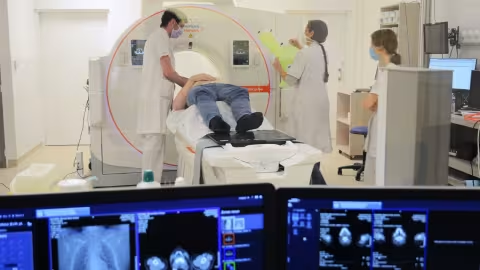
Two photon-counting CT scanners now equip Gustave Roussy's imaging department
Since September 2026, Gustave Roussy's Department of Medical Imaging has been equipped with a second photon-counting CT scanner, delivering higher image resolution while reducing the doses of X-rays and contrast agent administered to patients. This technology recently enabled the Institute to perform an iodine-free pulmonary CT angiogram, a world first.

-
Prevention and screening: getting ahead of lung cancer
To mark Thoracic Cancer Awareness Month and Tobacco-Free Month, two campaigns focusing on lung cancer, Gustave Roussy highlights its initiatives to advance prevention and screening among people at increased risk. Since its creation in 2021, the Institute’s Interception Lung programme has welcomed more than 900 participants, supporting them to stop smoking and offering personalised screening for the disease.
-
Gustave Roussy Meets His Audience
As part of its awareness-raising and fundraising efforts, Gustave Roussy is currently conducting a door-to-door outreach campaign in several towns in Val-de-Marne (Fresnes, Vitry-sur-Seine, Nogent-sur-Marne, Bry-sur-Marne, Le Kremlin-Bicêtre) from Monday through Saturday, 1:30 p.m. to 8:00 p.m.

-
Mens November: Take care of your jewelry its precious!
November is the month dedicated to raising awareness and promoting prevention of male cancers, which include prostate, testicular, and penile cancers. The goal is to raise public awareness of these diseases—which account for approximately 63,000 new cases in France each year—and to encourage men to perform testicular self-exams, a simple step that can help detect a lump, the nature of which must then be determined through further medical examinations. Gustave Roussy has extensive expertise in the treatment of male cancers, particularly through its Genitourinary Oncology Committee, which is deeply involved in research on these diseases.