Welcome to the new Gustave Roussy website
A new website designed to offer you a simpler, clearer, and more intuitive experience. Patients, caregivers, healthcare professionals, and donors: find information, news, and services more easily.
Research Focus – Breast cancer, immunotherapy, AI… Three Other Breakthroughs to Watch
Last quarter, we also learned that a blood test can help personalise treatments prescribed to women with breast cancer, that certain immune cells are responsible for reduced immunotherapy efficacy, and that artificial intelligence can be used to better understand how cells are organised within tumours.
Published on
Last quarter, we also learned that a blood test can help personalise treatments prescribed to women with breast cancer, that certain immune cells are responsible for reduced immunotherapy efficacy, and that artificial intelligence can be used to better understand how cells are organised within tumours.
Adapting the therapeutic strategy for high-risk breast cancer patients during treatment, using circulating tumour DNA
In patients with HR-positive, HER2-negative breast cancer, resistance to hormone therapy and CDK4/6 inhibitor treatments is a common occurrence. However, it is not currently possible to identify in advance which patients will respond well to these treatments, and which will develop resistance.
To address this challenge, researchers from the IHU Prism at Gustave Roussy, together with CentraleSupélec and the Unicancer network, explored the use of circulating tumour DNA, small DNA fragments originating from tumour cells that are detectable in the blood. Their findings show that both the initial level of circulating tumour DNA and its evolution during the early phases of treatment are strongly associated with the risk of disease progression and with patient survival.
This approach could offer a means of identifying very early on which patients are unlikely to respond well to treatment, before any disease progression becomes visible on imaging. In the longer term, this could allow therapeutic strategies to be adjusted more swiftly for these patients.
Prognostic significance of early on-treatment evolution of circulating tumor DNA in advanced ER-positive/HER2-negative breast cancer
Mamann, A. et al., Annals of Oncology, Volume 36, Issue 11, 1342 - 1355
Better understanding why immunotherapy does not work for all patients
Immunotherapy has profoundly transformed the management of many cancers. Yet these innovative treatments are not effective in all patients, and the reasons for these failures remain poorly understood.
In a study published in the international journal Nature Immunology, researchers from Gustave Roussy contributed to a better understanding of the role played by certain immune system cells, known as dendritic cells, within human tumours. These cells have a central role in activating the immune system's defences against cancer.
By analysing data from thousands of cells across different tumour types, the researchers identified specific dendritic cell profiles associated with reduced immunotherapy efficacy. Some of these cells appear to suppress the activation of the lymphocytes tasked with destroying cancer cells.
These findings improve our understanding of why certain patients respond less well to immunotherapy. In the longer term, they could help to more precisely identify patients likely to benefit from these treatments and to develop new strategies to improve their effectiveness.
DC subsets and states unraveled across human juxtatumoral and malignant tissues
Mulder K. et al., Nature Immunology, 2025
Artificial intelligence to better understand the organisation of tissues and tumours
To better understand how an organ or tumour functions, it is not enough to know which cells are present. It is equally important to understand where they are located within the tissue and how they interact with one another. This is precisely what spatial transcriptomics enables: a cutting-edge technology that analyses gene activity whilst preserving the exact position of cells within tissues.
However, this wealth of information presents a major challenge: the data generated are extremely complex, often produced using different technologies, and difficult to compare across samples.
In a study published in the journal Nature Methods, researchers from Gustave Roussy and CentraleSupélec developed Novae, a new artificial intelligence tool capable of analysing these data in a robust and standardised manner. One of Novae's key strengths is its ability to compare data from different technologies whilst automatically correcting for technical biases. The tool can thus identify common structures across multiple samples, as well as organisational patterns specific to certain diseases, including cancers.
By facilitating the analysis and large-scale comparison of complex data, Novae opens new prospects for biomedical research. In the longer term, this tool could help researchers to better understand the tumour microenvironment.
Novae: a graph-based foundation model for spatial transcriptomics data
Blampey Q. et al., Nature Methods, 2025
Last news
-
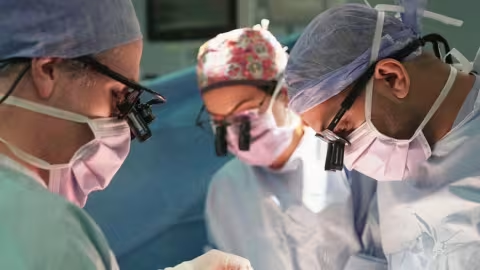
Breast Cancer: Gustave Roussy Ranked No. 1 in France for Breast Surgery and Breast Reconstruction
On the occasion of Breast Cancer Awareness Month, the 2025 data from Visuchir, the national surgical activity monitoring tool of the French Health Insurance system, places Gustave Roussy in first position for both breast surgery and breast reconstruction. Beyond this ranking, these figures highlight that reconstruction is now an integral part of breast cancer treatment. It is considered at every stage of care: from tumor removal surgery, whether lumpectomy or mastectomy, through to the post-cancer period, helping to restore the body and support women in regaining their physical integrity and quality of life.
-
Newsweek Ranking: Gustave Roussy Named Europe’s Leading Cancer Centre and Third Best Worldwide
The 2027 edition of Newsweek’s World's Best Specialized Hospitals ranking once again recognises Gustave Roussy as the leading cancer centre in France and Europe, and the third best worldwide. This distinction highlights the excellence of the Institute’s care and research, as well as the daily commitment of all its professionals.

-
Living with and beyond cancer: the promises and challenges of digital health
In a Viewpoint article published in The Lancet Digital Health, Drs Ines Vaz-Luis and Maria Alice Franzoi, together with Emmanuel Mussault, a patient partner at the PRISM University Hospital Institute, examine the role that digital tools can play in supporting people living with and beyond cancer. Their central message is that these technologies can support more personalised and accessible care, but their value depends primarily on how they are integrated into care pathways, the human support provided, their ability to address individual needs and their evaluation in real-world settings.
-
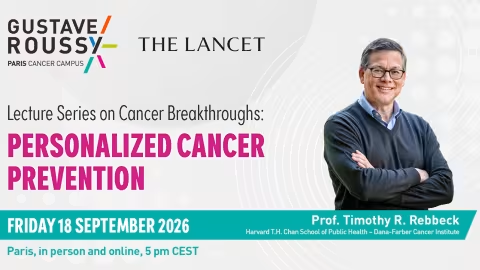
Gustave Roussy and The Lancet launch an international lecture series on innovations transforming cancer care
The inaugural lecture in the “Lecture Series on Cancer Breakthroughs” will take place on Friday 18 September at 5:00 pm. It will be delivered by Professor Timothy R. Rebbeck, a leading cancer prevention specialist at Harvard University and the Dana-Farber Cancer Institute.