Welcome to the new Gustave Roussy website
A new website designed to offer you a simpler, clearer, and more intuitive experience. Patients, caregivers, healthcare professionals, and donors: find information, news, and services more easily.
Stories from Those Affected – Perrine, Diagnosed Early with Pancreatic Cancer
This year, Gustave Roussy’s Clinical Research Week is focused on personalized prevention. To mark the occasion, Perrine, the Institute’s Director of Brand and Philanthropy, reflects on the pancreatic cancer she was diagnosed with at an early stage less than a year ago. This is a rare occurrence, made possible by the Interception cancer prevention program.
Published on
Changed on
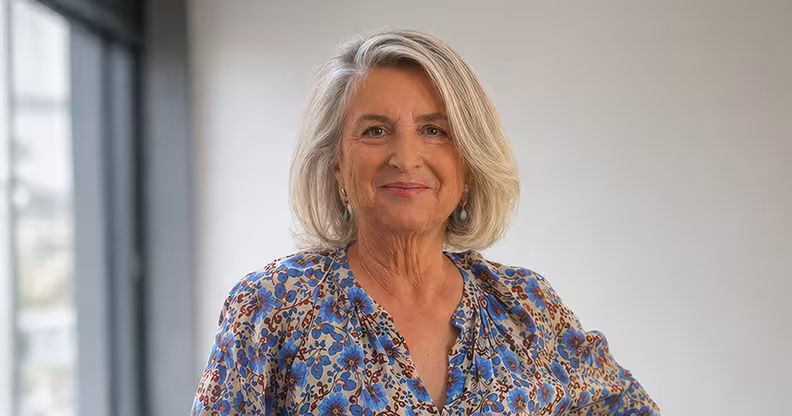
This year, Gustave Roussy’s Clinical Research Week is focused on personalized prevention. On this occasion, Perrine, the Institute’s Director of Brand and Philanthropy, reflects on the pancreatic cancer she was diagnosed with at an early stage less than a year ago—a rare occurrence made possible by the Interception cancer prevention program.
“I come from a family deeply affected by cancer. My parents, my sister, my cousins, and an uncle have all battled the disease, though no predisposing gene has been identified to date. I myself had already been treated for breast cancer in 2008.
Then, in 2021, Gustave Roussy launched the Interception program, focused on personalized cancer prevention. The pathways dedicated to breast and lung cancers were the first to open, followed later by those focused on gastrointestinal and pancreatic tumors.
It was my professional curiosity—not my personal curiosity—that was piqued first. I didn’t know much about the risk factors for pancreatic cancer, but when I mentioned that two people close to me—my mother and my uncle—had been diagnosed with this cancer, I was told I was eligible.
I arrived at the event feeling very relaxed; I had signed up without really thinking about my level of risk. The welcome was warm, and the day’s program was organized around various workshops: physical activity tests, a medical checkup, discussions about nutrition… At the end of the day, the oncologist explained that in cases of increased risk, the recommended practice is to have an MRI of the pancreas every other year, supplemented by an endoscopic ultrasound of the pancreas in the intervening years. The goal is to detect the disease as early as possible, which happens in very few cases since, unfortunately, the symptoms of this cancer don’t appear until the tumor has spread too far to be surgically removed.
I performed these exams at Gustave Roussy using a state-of-the-art MRI machine. It detected a lesion measuring just 7 mm, which would have gone unnoticed 10 years earlier. Dr. Max Gelli, head of the Department of Anesthesia, Surgery, and Interventional Procedures at Gustave Roussy, immediately requested that the nature of this lesion be identified. So I had a biopsy done right away, and the diagnosis came back: stage I pancreatic cancer. The doctors immediately reassured me, explaining that my prognosis was very favorable. But of course, my anxiety set in, accompanied by all the memories tied to my family history.
Diagnosed on June 11, I was in the operating room on July 1. The surgery lasted eight hours. It was performed by Dr. Gelli, assisted by a robot that left only three small incisions and allowed the tumor to be removed along with a significant portion of the pancreas, which has left me with diabetes today. This was followed by a week in the hospital, marked by the compassion of the staff at Gustave Roussy, who showered me with small gestures of kindness, words of encouragement, and reassuring hand gestures that brought me great comfort. The first few days went fairly well, aside from a side effect of the anesthesia that no one had ever mentioned to me: postoperative depression, no doubt linked to being artificially sedated for eight hours. Trusting the medical teams and letting them take care of me helped dispel the anxiety that had consumed me since my diagnosis.
After my hospital stay, I had only one thing on my mind: recovering in the countryside. I regained my strength, went for walks, and did respiratory physical therapy. Fifteen days later, another complication arose: acute pancreatitis, which required another hospital stay. Everything eventually returned to normal, although it was a difficult time, marked by the loss of an old friend to pancreatic cancer.
I was able to start my chemotherapy—which is quite intense for this type of cancer—at the end of August to reduce the risk of relapse. That didn’t stop me from celebrating my son’s wedding after my first session—a beautiful and joyful moment. Fortunately, the bride and groom didn’t notice a thing when my blood sugar monitoring app started beeping right as they were exchanging vows!
During my chemotherapy treatments, I talked a lot with the other patients and met some wonderful people. When I told them I had pancreatic cancer, I could see in their eyes that they thought I was a lost cause. When I tried to explain myself—to tell them that the tumor had been caught extremely early thanks to Interception—they thought I was in denial. This highlights the need to raise awareness about cancer prevention among a larger portion of the population. Thanks to Interception, I was undergoing chemotherapy as a precaution, not to save my life—which makes all the difference…
I finally finished my chemotherapy on February 8. I now have to get a CT scan every three months, mainly to monitor my pancreatitis, as well as blood tests. Today, I realize how lucky I am, with the keen awareness that donations most certainly saved my life: it is generosity that has given brilliant, visionary doctors and surgeons the means to provide smart, personalized medicine and access to cutting-edge technology!
I returned to work on May 12, less than a year after my diagnosis. This is an extremely rare occurrence in pancreatic cancer. It demonstrates just how unique and particularly relevant the Gustave Roussy prevention program—conceived by Dr. Suzette Delaloge—is. A cancer this small cannot be discovered by chance. My story shows that for people with a strong genetic predisposition, a personalized prevention program is essential and can save lives.
I was already motivated to raise funds to support Gustave Roussy. Now I’m even more so. These days, every time my children raise their glasses, they say, ‘To Suzette!’”
Last news
-
Breast Cancer: Gustave Roussy Ranked No. 1 in France for Breast Surgery and Breast Reconstruction
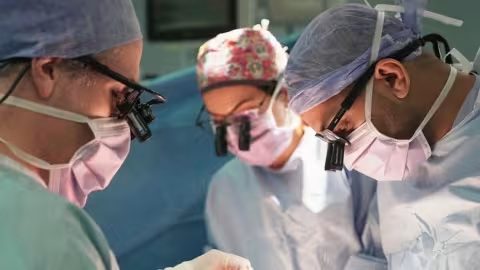
On the occasion of Breast Cancer Awareness Month, the 2025 data from Visuchir, the national surgical activity monitoring tool of the French Health Insurance system, places Gustave Roussy in first position for both breast surgery and breast reconstruction. Beyond this ranking, these figures highlight that reconstruction is now an integral part of breast cancer treatment. It is considered at every stage of care: from tumor removal surgery, whether lumpectomy or mastectomy, through to the post-cancer period, helping to restore the body and support women in regaining their physical integrity and quality of life.
-
Newsweek Ranking: Gustave Roussy Named Europe’s Leading Cancer Centre and Third Best Worldwide
The 2027 edition of Newsweek’s World's Best Specialized Hospitals ranking once again recognises Gustave Roussy as the leading cancer centre in France and Europe, and the third best worldwide. This distinction highlights the excellence of the Institute’s care and research, as well as the daily commitment of all its professionals.
-
Living with and beyond cancer: the promises and challenges of digital health
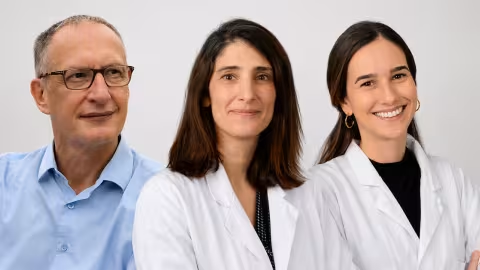
In a Viewpoint article published in The Lancet Digital Health, Drs Ines Vaz-Luis and Maria Alice Franzoi, together with Emmanuel Mussault, a patient partner at the PRISM University Hospital Institute, examine the role that digital tools can play in supporting people living with and beyond cancer. Their central message is that these technologies can support more personalised and accessible care, but their value depends primarily on how they are integrated into care pathways, the human support provided, their ability to address individual needs and their evaluation in real-world settings.
-
Gustave Roussy and The Lancet launch an international lecture series on innovations transforming cancer care
The inaugural lecture in the “Lecture Series on Cancer Breakthroughs” will take place on Friday 18 September at 5:00 pm. It will be delivered by Professor Timothy R. Rebbeck, a leading cancer prevention specialist at Harvard University and the Dana-Farber Cancer Institute.