Welcome to the new Gustave Roussy website
A new website designed to offer you a simpler, clearer, and more intuitive experience. Patients, caregivers, healthcare professionals, and donors: find information, news, and services more easily.
Sun protection: the right habits to properly protect your skin
Summer invites us outdoors — vacations, walks, long days in the sun. But enjoying the sunshine shouldn't mean forgetting the risks linked to ultraviolet (UV) radiation, the leading cause of premature skin ageing and skin cancer. Choosing the right sunscreen, applying it correctly, and adopting good habits are the best allies for enjoying summer while protecting your skin. A closer look at the right habits with Dr. Djaouida Belkadi-Sadou, dermatologist at Gustave Roussy.
Published on

Summer invites us outdoors — vacations, walks, long days in the sun. But enjoying the sunshine shouldn't mean forgetting the risks linked to ultraviolet (UV) radiation, the leading cause of premature skin ageing and skin cancer. Choosing the right sunscreen, applying it correctly, and adopting good habits are the best allies for enjoying summer while protecting your skin. A closer look at the right habits with Dr. Djaouida Belkadi-Sadou, dermatologist at Gustave Roussy.
Why is clothing the first line of sun protection?

Contrary to a widely held belief, sunscreen is not the first line of defense against ultraviolet (UV) radiation. It comes as a complement to clothing and other so-called behavioral measures.
It is recommended to:
- wear textiles labeled UPF 50+, which block more than 98% of UVA and UVB rays (except for swimwear)
- choose a wide-brimmed hat (at least 7 cm) to protect the face, ears, and neck
- wear CE-marked sunglasses to protect the eyes
- reserve sunscreen for parts of the body that remain uncovered
- favor shaded areas
This “clothing first, sunscreen second” strategy offers more reliable protection, reduces the risk of forgetting to reapply, and limits direct UV exposure, particularly between 11 a.m. and 4 p.m., when UV intensity is at its peak.
UVA, UVB: what's the difference?
Two types of UV rays reach our skin, UVA and UVB, since the ozone layer absorbs 100% of UVC rays.
- UVB rays penetrate the skin's superficial layer (the epidermis). They are responsible for sunburn and play a major role in the development of skin cancers.
- UVA rays penetrate more deeply, reaching the deep dermis, including through glass or on cloudy days. Less immediately visible, they accelerate skin ageing (photoageing) and also contribute to the development of skin cancers.
This is why it is essential to choose a sunscreen that protects against both UVA and UVB, with a sun protection factor (SPF) of 50+, regardless of skin type.
What does the SPF rating actually mean?
SPF (Sun Protection Factor) measures only protection against UVB rays.
For example:
- an SPF 30 filters about 96% of UVB rays
- an SPF 50 filters about 98% of UVB rays.
The gap may look small in percentage terms, but it corresponds to a significant reduction in the amount of radiation reaching the skin. With repeated or prolonged exposure, this difference becomes significant.
That said, no sunscreen blocks 100% of UVB rays.
SPF therefore says nothing about protection against UVA rays. To make sure a product also protects against UVA, check for the wording “broad spectrum” or the UVA logo (a circled “UVA”), which guarantees protection in line with European recommendations.
Mineral filters or organic filters: what's the difference?
Sunscreens use two main families of filters.
- Mineral filters (titanium dioxide, zinc oxide) reflect and scatter part of the UV radiation at the skin's surface.
- Organic filters (often called chemical filters) absorb UV rays and then release their energy as heat.
Both types of filters are effective when properly formulated and used. The choice mainly depends on skin tolerance and personal preference.
For children, recommendations generally favor sunscreens based on mineral filters, for their gentler tolerance profile and low skin penetration.
How should sunscreen be applied correctly?

Sunscreen applied incorrectly loses much of its effectiveness. A few simple rules to follow:
- Applying enough product is a key factor. A simple way to apply the recommended amount is the two-finger rule (draw a line of cream along the full length of the index and middle fingers, then apply it to the face and neck).
- Reapply every two to three hours, and always after swimming, exercising, or heavy sweating.
- Apply 20 to 30 minutes before sun exposure, to let the product settle onto the skin. Don't forget sensitive areas: ears, neck, scalp (in cases of thinning hair or baldness), lips.
- Check the expiration date: a sunscreen opened more than a year ago loses effectiveness. Beyond this possible drop in efficacy, it often also suggests that the amounts applied were insufficient (chronic under-application) to ensure optimal photoprotection.
Why does quantity matter so much?
SPF ratings are determined in the laboratory using a standardized quantity of 2 mg of product per cm² of skin.
In practice, most people apply two to four times less sunscreen than the amount used in testing. An SPF 50 sunscreen applied in too thin a layer can therefore offer significantly less protection than what's stated on the packaging.
Why is reapplication necessary?
Over time, the protective layer breaks down due to several factors: UV radiation, sweating, friction from clothing or towels, and swimming.
Even products described as water-resistant only retain their effectiveness for a limited time, assessed using standardized protocols. It is therefore essential to reapply sunscreen after every swim, even when the product is labeled waterproof.
Is sunscreen useful for darker skin tones?
Melanin provides natural protection against UV rays, particularly UVB. However, this protection is partial and remains insufficient to prevent all of the harmful effects of the sun, particularly those linked to UVA rays and visible light.
While the overall risk of skin cancer is lower in people with darker skin phototypes, pigmentary disorders are more common and often more severe. Sun protection therefore remains essential, including for darker skin tones.
Why protect your skin during and after cancer treatment?
Certain chemotherapies, targeted therapies, immunotherapies, or radiotherapies can make the skin more sensitive to the sun (photosensitization). Recent scars and areas that have received radiotherapy also require enhanced protection.
Before summer, it is advisable to talk to your care team or oncologist to find out which precautions are suited to your situation and the treatments you have received.
Sun protection is a full part of the measures used to preserve skin health, both during and after treatment.
Does sun protection reduce vitamin D production?
Using sunscreen does not cause a vitamin D deficiency. In addition, about fifteen minutes of sun exposure per day is considered enough to avoid deficiency. If needed, simple oral supplementation can be offered in cases of confirmed vitamin D deficiency.
Deliberate unprotected sun exposure is not recommended as a strategy for maintaining an adequate vitamin D status.
Last news
-
Breast Cancer: Gustave Roussy Ranked No. 1 in France for Breast Surgery and Breast Reconstruction
On the occasion of Breast Cancer Awareness Month, the 2025 data from Visuchir, the national surgical activity monitoring tool of the French Health Insurance system, places Gustave Roussy in first position for both breast surgery and breast reconstruction. Beyond this ranking, these figures highlight that reconstruction is now an integral part of breast cancer treatment. It is considered at every stage of care: from tumor removal surgery, whether lumpectomy or mastectomy, through to the post-cancer period, helping to restore the body and support women in regaining their physical integrity and quality of life.

-
Newsweek Ranking: Gustave Roussy Named Europe’s Leading Cancer Centre and Third Best Worldwide
The 2027 edition of Newsweek’s World's Best Specialized Hospitals ranking once again recognises Gustave Roussy as the leading cancer centre in France and Europe, and the third best worldwide. This distinction highlights the excellence of the Institute’s care and research, as well as the daily commitment of all its professionals.

-
Living with and beyond cancer: the promises and challenges of digital health
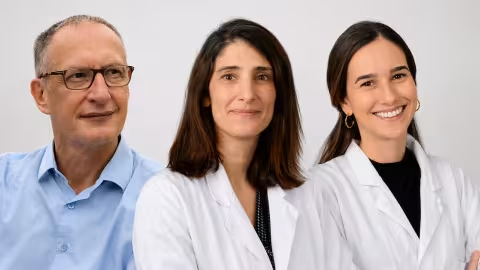
In a Viewpoint article published in The Lancet Digital Health, Drs Ines Vaz-Luis and Maria Alice Franzoi, together with Emmanuel Mussault, a patient partner at the PRISM University Hospital Institute, examine the role that digital tools can play in supporting people living with and beyond cancer. Their central message is that these technologies can support more personalised and accessible care, but their value depends primarily on how they are integrated into care pathways, the human support provided, their ability to address individual needs and their evaluation in real-world settings.
-
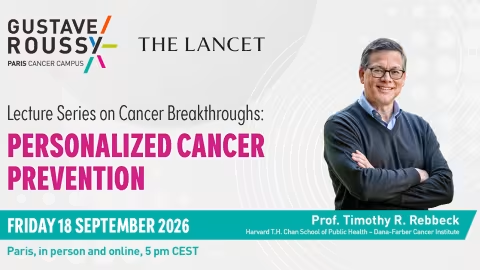
Gustave Roussy and The Lancet launch an international lecture series on innovations transforming cancer care
The inaugural lecture in the “Lecture Series on Cancer Breakthroughs” will take place on Friday 18 September at 5:00 pm. It will be delivered by Professor Timothy R. Rebbeck, a leading cancer prevention specialist at Harvard University and the Dana-Farber Cancer Institute.