Welcome to the new Gustave Roussy website
A new website designed to offer you a simpler, clearer, and more intuitive experience. Patients, caregivers, healthcare professionals, and donors: find information, news, and services more easily.
Precision drug to stimulate immune system against some cancers
Gustave Roussy's researchers found an unkown ability to PARP inihibitors - a precision cancer drug used against breast and ovarian cancer - to stimulate the immune system. This study suggests to developp new combinaisons of treatments with immunotherapy.
Published on
Changed on
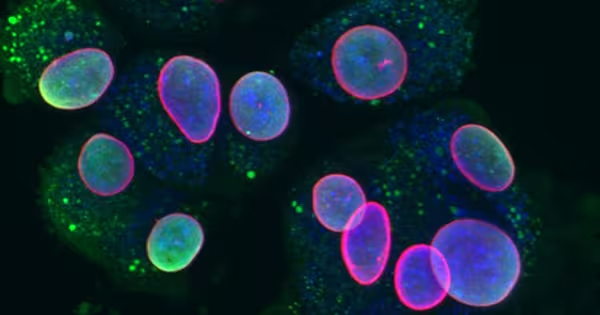
Gustave Roussy's researchers found an unkown ability to PARP inihibitors - a precision cancer drug used against breast and ovarian cancer - to stimulate the immune system. This study suggests to developp new combinaisons of treatments with immunotherapy.
Block DNA repair in cancer cells
Cells accumulate DNA damages that would be repaired to survive. The PARP inhibitors block one of the system cancer cells use to repair their DNA. So, the number of damages inscreases more and more until the cancer cells die.
This mechanism shows how PARP inhibitors can destroyed precisely cancer cells with DNA mutation, like BRCA1 (ovarian, breast and prostate cancers) or ERCC1 (lung cancers).
Boost the patient immune system
Recently, a researchers team, led by Dr. Sophie Postel-Vinay from Gustave Roussy and Prof. Chris Lord from The Institute of Cancer Research, found a new potential for PARP inhibitors to boost the immune system against the tumor.
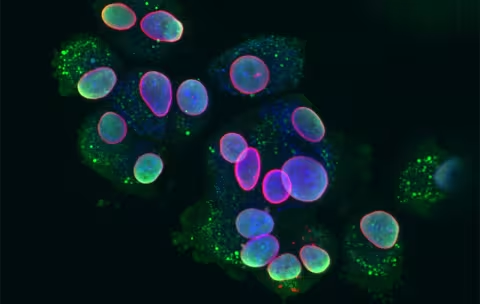
The researchers found that lung cancers with deficiencies in their DNA repair contained significantly more immune cells within the tumours, compared with tumours in patients with a functioning DNA repair system. This suggested that the DNA repair mutations were stimulating an immune response against the tumours. Studying cancer cells from non-small cell lung cancers and triple-negative breast cancers with mutations in DNA repair genes such as ERCC1 or BRCA, the researchers revealed that the accumulation of DNA damage in cancer cells treated with PARP inhibitors triggered the release of various molecular signals that have the potential to attract immune cells to the tumour.
"We knew PARP inhibitors can kill precisely cancer cells with damages by blocking DNA repair. But our study showed that PARP inhibitors help immune cells to infiltrate the tumor, influencing interaction between tumor cells and their immune microenvironment" explains Dr. Roman Chabanon, PhD in Oncology - Philanthropia Foundation - and biologist responsible of this research project. "The findings of this study substantially change our perception of these drugs potential."
Combinate treatments to increase the immunotherapy effects
The study opens up a new way of treating cancers using PARP inhibitors alongside immunotherapy.
Dr Sophie Postel-Vinay, clinician scientist and medical oncologist at Gustave Roussy, said: "Our study found that PARP inhibitors enlist immune cells to aid in the killing of cancer cells. This provides a rationale for using PARP inhibitors alongside immunotherapies to further stimulate the immune response to cancer cells with DNA repair defects and enhance the therapeutic benefit of the treatment. This will be evaluated in a clinical trial that we developped which will associate a PARP inhibitor with immunotherapy. This clinical study will start at Gustave Roussy in 2019, enrolling patients with lung, prostate and bladder cancers."
Their study was funded by the Inserm ATIP-Avenir programme, SIRIC Socrates, the Philanthropia Foundation and Cancer Research UK and is published in the Journal of Clinical Investigation.
Last news
-
Breast Cancer: Gustave Roussy Ranked No. 1 in France for Breast Surgery and Breast Reconstruction
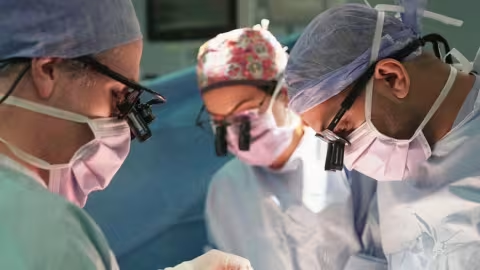
On the occasion of Breast Cancer Awareness Month, the 2025 data from Visuchir, the national surgical activity monitoring tool of the French Health Insurance system, places Gustave Roussy in first position for both breast surgery and breast reconstruction. Beyond this ranking, these figures highlight that reconstruction is now an integral part of breast cancer treatment. It is considered at every stage of care: from tumor removal surgery, whether lumpectomy or mastectomy, through to the post-cancer period, helping to restore the body and support women in regaining their physical integrity and quality of life.
-
Newsweek Ranking: Gustave Roussy Named Europe’s Leading Cancer Centre and Third Best Worldwide
The 2027 edition of Newsweek’s World's Best Specialized Hospitals ranking once again recognises Gustave Roussy as the leading cancer centre in France and Europe, and the third best worldwide. This distinction highlights the excellence of the Institute’s care and research, as well as the daily commitment of all its professionals.

-
Living with and beyond cancer: the promises and challenges of digital health
In a Viewpoint article published in The Lancet Digital Health, Drs Ines Vaz-Luis and Maria Alice Franzoi, together with Emmanuel Mussault, a patient partner at the PRISM University Hospital Institute, examine the role that digital tools can play in supporting people living with and beyond cancer. Their central message is that these technologies can support more personalised and accessible care, but their value depends primarily on how they are integrated into care pathways, the human support provided, their ability to address individual needs and their evaluation in real-world settings.
-
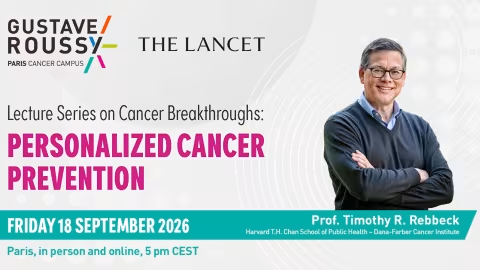
Gustave Roussy and The Lancet launch an international lecture series on innovations transforming cancer care
The inaugural lecture in the “Lecture Series on Cancer Breakthroughs” will take place on Friday 18 September at 5:00 pm. It will be delivered by Professor Timothy R. Rebbeck, a leading cancer prevention specialist at Harvard University and the Dana-Farber Cancer Institute.