
Welcome to the new Gustave Roussy website
A new website designed to offer you a simpler, clearer, and more intuitive experience. Patients, caregivers, healthcare professionals, and donors: find information, news, and services more easily.
HPV-related cancers
Director
Dr. Judith Michels
Contact
+33 (0)1 42 11 43 76
Understanding the Disease
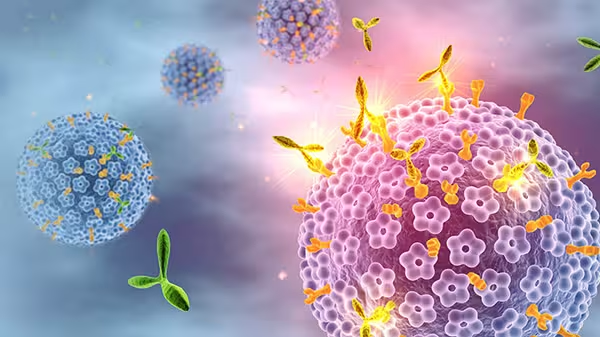
HPV-related cancers are cancers linked to a persistent infection with certain human papillomaviruses (HPV). These very common viruses are transmitted primarily through sexual contact. In most cases, the body clears HPV on its own. However, when the infection persists, it can lead, over the years, to precancerous lesions and eventually to cancer.
There are several types of cancers associated with HPV:
-
Cervical cancers, which are most commonly linked to HPV.
-
Anal cancers.
-
Oropharyngeal cancers (particularly of the tonsils and the base of the tongue).
-
Vaginal and vulvar cancers.
-
Penile cancers.
These cancers are primarily caused by certain “high-risk” HPV types, particularly types 16 and 18.
These cancers generally develop slowly, progressing through detectable and treatable precancerous lesions, which is why screening is so important—especially for cervical cancer.
HPV-related cancers can affect both women and men. Certain factors increase the risk of persistent infection, such as smoking or a weakened immune system.
What is HPV?
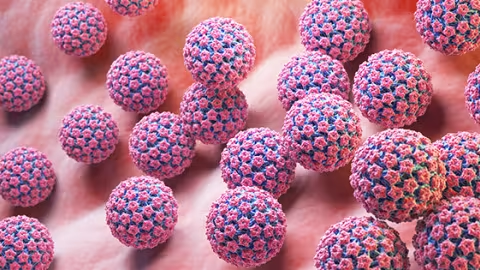
HPV, or human papillomavirus, is a very common family of viruses transmitted primarily through sexual contact. Most people are exposed to it at some point in their lives without realizing it, as the infection often clears up on its own. However, certain types of HPV can persist and, over the long term, cause lesions that may develop into cancers (such as cervical, anal, or throat cancer).
Vaccination and screening are effective ways to prevent these cancers.
Prevention
HPV Vaccination
There is a safe and effective vaccine to protect against HPV infections. In France, the vaccine used protects against nine different types of HPV, including those most commonly associated with cancer. Getting vaccinated can prevent up to 90% of HPV infections that can lead to cancer.
To maximize its effectiveness, this vaccine should be administered before young girls and boys become sexually active—that is, before any potential exposure to the papillomavirus. However, catch-up vaccination is possible up to age 26.
In France, the HPV vaccine is recommended:
-
For all girls and boys aged 11 to 14, with two doses administered 5 months apart. The vaccine is offered free of charge in middle schools to 5th- and 4th-year students, subject to parental consent.
-
As a catch-up vaccination, for all girls and boys aged 15 to 26, with three doses required in this case.
To get vaccinated, you can contact your doctor, pharmacist, midwife, nurse, or a municipal or departmental vaccination service.
Cervical Cancer Screening
Screening helps identify chronic infection with a high-risk (oncogenic) HPV strain and detect and treat precancerous lesions before they develop into cervical cancer. However, this disease remains the 11th leading cause of cancer-related deaths among women in France, with more than 1,000 deaths per year. Hence the importance of the national screening program launched in 2018, for women whether vaccinated or not. This screening program is based on:
-
Ages 25 to 29: two Pap smears (cytological exams) one year apart to check for abnormal cells. If both results are normal, another screening is performed three years later.
-
Ages 30 to 65: A PCR test is used to directly detect the presence of a so-called high-risk oncogenic HPV virus (HPV-HR test) in the Pap smear. If the test is positive, the Pap smear is then examined for abnormal cells. This PCR test should be performed every five years, beginning either three years after the last normal Pap test or at age 30 if no screening has yet been performed. It is the chronic presence of the virus (several consecutive positive test results) that is a potential risk factor for cellular transformation.
In France, gynecological checkups are not mandatory (except during pregnancy), but are recommended starting when a woman becomes sexually active, with a primary care physician, a midwife, or a gynecologist. Apart from regular checkups (which only 60% of women undergo), certain symptoms should prompt an immediate visit to a healthcare provider:
-
Abnormal vaginal bleeding;
-
Pain during intercourse;
-
Unusual discharge;
-
Pelvic or lower back pain.
Coverage
Established in December 2022, Gustave Roussy’s cross-departmental working group specializing in the management of cancers caused by human papillomavirus (HPV) infections brings together professionals from various specialties involved in the study and management of HPV:
-
Medical oncologists and radiation oncologists,
-
Gynecologists, ENT specialists, gastroenterologists/proctologists, urologists, dermatologists, and surgeons,
-
Pathologists,
-
Biologists, virologists, epidemiologists, and statisticians
This HPV group aims to develop a clinical and translational research program focused on all HPV-induced cancers. The goal is to pool our resources to provide access to therapeutic innovations by treating HPV-related cancers as a single entity, thereby fostering multidisciplinary care and research, as well as promoting primary and secondary prevention of HPV-related cancers.
Care Pathway
At Gustave Roussy, several treatment pathways are available, including:
Gynecological consultations (medical and/or surgical) for the screening and management of:
- High-grade HPV-induced cervical lesions.
- High-grade HPV-induced vulvar lesions.
- HPV-induced lesions of the anal margin and anal canal in cases where risk factors are present.
Oncology and radiation oncology consultations for personalized treatment (including potential participation in research programs and clinical trials) of:
-
Cancers of the cervix, vulva, or vagina.
-
HPV-induced cancers and lesions of the anal margin and anal canal; with possible inclusion in a research program offering detection of circulating tumor DNA and/or in clinical trials with access to innovative treatments.
-
HPV-induced ENT cancers and lesions.
-
HPV-induced male urogenital cancers and lesions.
Appointments and Second Opinions

Eradicating Cancers Caused by Human Papillomavirus (HPV)
In 2023, a national human papillomavirus (HPV) vaccination campaign was launched in middle schools to strengthen prevention efforts against these very common infections.
HPV is responsible for the fifth leading cause of cancer worldwide. In particular, it causes nearly all cases of cervical cancer and about half of all oropharyngeal cancers. It can also cause other, rarer cancers affecting the vagina, vulva, anus, penis, or certain areas of the skin.
Each year in France, approximately 8,000 HPV-related cancers and 30,000 precancerous lesions could be prevented through vaccination. These highly prevalent viruses are transmitted primarily through sexual contact and are usually asymptomatic.
Vaccination is currently the most effective preventive measure. It is recommended by the World Health Organization starting at age 9. In France, the Haute Autorité de Santé recommends vaccination for girls and boys between the ages of 11 and 14, with catch-up vaccination available up to age 19.
Despite these recommendations, vaccination coverage remains insufficient to bring about a significant reduction in HPV-related cancers. National and scientific initiatives are therefore aimed at improving public awareness and increasing vaccination uptake.
Patient Organizations and Charity Sports Events
"Tomorrow Without HPV" is a coalition of 10 patient organizations working to accelerate prevention and improve screening for HPV-related diseases.
The Nicola Werner Challenge (NWC) is a major cycling race held across Europe and North America to raise funds for young cancer researchers.
Clinical Trials and Therapeutic Innovation
Depending on the characteristics and stage of the cancer, doctors at Gustave Roussy may offer patients the opportunity to participate in clinical research trials. If appropriate, referral to a clinical trial will be discussed with patients during their care with their referring oncologist, allowing them to access innovative treatments.
→ View ongoing clinical trials for HPV-related cancers [notes: add link]
-
Throat cancer and HPV: better understanding for better protection
On World Human Papillomavirus (HPV) Awareness Day, Gustave Roussy is drawing attention to oropharyngeal cancers – throat cancers affecting the tonsils, soft palate, base of the tongue, and the back of the throat. In many cases, the cause is the human papillomavirus (HPV), a virus transmitted mainly through sexual contact that affects both men and women.
-
Cancers ORL : les symptômes qui doivent alerter
Du 30 mars au 5 avril 2026 est organisée en France la campagne Rouge-Gorge, dédiée à la sensibilisation aux cancers de la gorge. À cette occasion, Gustave Roussy se mobilise et rappelle les signaux qui doivent alerter et amener à consulter un professionnel de santé. En France, entre 15 000 et 16 000 nouveaux cas de cancers ORL sont diagnostiqués chaque année, selon les données de l’Inca. Le jeudi 2 avril, les experts du comité ORL de Gustave Roussy seront présents sur le parvis de La Défense pour sensibiliser le grand public à ces pathologies.
-
Les dernières avancées dans le traitement des cancers ORL
Du 15 au 20 septembre, la campagne « Make-Sense, Prendre le cancer à la gorge » se déploie sur différents canaux pour sensibiliser aux cancers ORL, qui touchent chaque année 15 000 nouveaux patients en France. À cette occasion, la Dr Ingrid Breuskin, chirurgienne et cheffe du comité ORL de Gustave Roussy, et la Dr Caroline Even, oncologue médicale, font le point sur les dernières avancées dans la prise en charge de ces pathologies. Gustave Roussy est un expert reconnu dans la prise en charge de ces cancers, comme en témoignent différents classements.
-
Cancer du col de l’utérus : se vacciner, se faire dépister et agir vite
Le cancer du col de l’utérus touche chaque année environ 3 000 femmes en France, alors qu’il pourrait être évité dans plus de neuf cas sur 10 grâce à la vaccination et à un dépistage régulier. À Gustave Roussy, le parcours InstaDiag Gynéco permet aujourd’hui un diagnostic rapide en cas de suspicion.