Welcome to the new Gustave Roussy website
A new website designed to offer you a simpler, clearer, and more intuitive experience. Patients, caregivers, healthcare professionals, and donors: find information, news, and services more easily.
Expand Colorectal Cancer Screening to Save Lives
Feature
Colorectal cancer, which claims the lives of more than 17,000 people in France each year, is nevertheless curable in 9 out of 10 cases if detected early. At Gustave Roussy, the entire medical staff is committed to promoting screening for this disease and providing better care for affected patients.
Colorectal cancer results from the transformation of a benign tumor called a polyp, located in the colon or rectum, into a malignant tumor. With more than 43,000 people diagnosed each year in France, it is the third most common cancer and the second leading cause of cancer-related deaths. In 2022, 17,100 people died from the disease.
However, when detected early, colorectal cancer is curable in 9 out of 10 cases. A national screening program is offered by the national health insurance system for people aged 50 to 74. Between 2021 and 2022, only 34.3% of those eligible took the screening test. The test, which is free and can be done at home, is designed to detect the presence of blood in the stool that is invisible to the naked eye. If the result is positive, the person is advised to undergo a colonoscopy.
A Preventable Cancer
Colorectal cancer is considered “preventable” insofar as several lifestyle-related risk factors can be avoided. Smoking, alcohol consumption, lack of physical activity, being overweight or obese, and a diet high in processed foods, low in fiber, or high in red meat are all factors that can contribute to the development of colorectal cancer.
However, other non-modifiable factors must also be taken into account. Age is a significant determinant, as are family history and genetic predisposition.
Care at Gustave Roussy
Personalized Prevention and Rapid Diagnosis
Recognizing that this disease is preventable, the Interception program—developed at the Institute—offers a care pathway specifically designed for individuals at high risk of developing colorectal cancer, such as those with Lynch syndrome.
The goal is to support these individuals and provide them with personalized follow-up care tailored to their lifestyle.
Gustave Roussy also offers a rapid diagnostic pathway to individuals with a positive screening test result or a family history of the disease. Called “Colodépist,” this program aims to reduce the anxiety patients experience due to complex and sometimes overly lengthy diagnostic processes.
An initial consultation is scheduled at the Institute with an anesthesiologist followed by a gastroenterologist to schedule a colonoscopy under general anesthesia within the following two weeks. The results of the outpatient procedure are provided to the patient the same day. A colonoscopy is the only test that can confirm the presence of colorectal cancer. It uses a camera to visualize the inside of the colon. If lesions are visible, they can be removed during the procedure if they are small. Otherwise, tissue samples are taken for analysis.
Providing patients with the latest therapeutic advances
Gustave Roussy, the leading cancer center in France and Europe and the fourth-largest in the world, treats 3,000 patients with colorectal cancer each year. The Institute offers comprehensive care for gastrointestinal cancers: endoscopy, imaging, surgery, radiation therapy, chemotherapy, targeted therapies, immunotherapy, and more. The development of precision medicine also relies on a new liquid biopsy platform (scheduled to open in 2024). This platform enables the detection of molecular abnormalities in cancer through a simple blood draw, allowing for the most effective therapeutic strategy. A multidisciplinary consultation meeting on gastrointestinal pathology is held every week.
In terms of equipment, the Da Vinci Xi robot enables minimally invasive surgeries. In 2023, Gustave Roussy acquired the Papillon+ contact radiotherapy device, capable of delivering radiation directly to the rectal mucosa. This technology may make it possible to avoid rectal resection.
On the research front, studies are evaluating the feasibility and efficacy of personalized medicine based on organoids (ORGANOTREAT) in patients with advanced or recurrent colorectal cancer or digestive cancers (particularly pancreatic cancer).
When a Polyp Develops into Colorectal Cancer
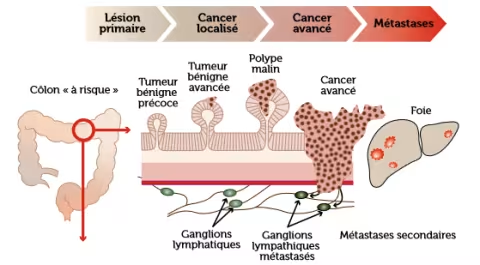
The degeneration of a polyp begins at its most superficial part, before invading deeper layers until it reaches and penetrates the intestinal wall. Tumor cells can then spread to the nearest lymph nodes and subsequently form metastases in the liver and lungs, complicating the treatment strategy. The patient’s life is then at risk. Conversely, when the malignant transformation is still limited to the surface of the polyp, its removal along with healthy surrounding tissue may be sufficient for a complete cure.
Symptoms to Watch For
- Bowel movement disturbances: constipation, diarrhea, nausea, feeling of incomplete bowel movement...
- Traces of blood in the stool
- Abdominal or rectal pain
- Weight loss, extreme fatigue...
Learn more
- Everything you need to know about the screening kit
- Colorectal cancer: For Blue March, Gustave Roussy launches the campaign “In March, check your toilet”
- Gastrointestinal cancer care at Gustave Roussy
- The YODA Program: Identifying and Assessing Environmental Risk Factors Linked to the Rise in Gastrointestinal Cancers Among Young People