Welcome to the new Gustave Roussy website
A new website designed to offer you a simpler, clearer, and more intuitive experience. Patients, caregivers, healthcare professionals, and donors: find information, news, and services more easily.
Kidney Cancer: A Complex Tumor
Often overlooked and asymptomatic, kidney cancer is considered one of the so-called “complex” cancers. Designated a “referral center” by the National Cancer Institute (INCa), Gustave Roussy treats this type of tumor and also conducts research to develop new treatments.
Published on
Changed on
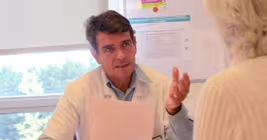
Often overlooked and asymptomatic, kidney cancer is considered one of the so-called “complex” cancers. Designated a “referral center” by the National Cancer Institute (INCa), Gustave Roussy treats this type of tumor and also conducts research to develop new treatments.
When a cell in the kidney multiplies uncontrollably, a tumor develops. In most cases, the cancer originates in the parenchyma—the tissue responsible for kidney function—and is called renal cell carcinoma. Because it presents few symptoms, kidney cancer may be discovered only by chance during tests performed for other reasons. As a result, in one-third of cases, the diagnosis is made at an advanced stage, when metastases are already present.
Treatments Tailored to the Stage of the Disease
When the cancer is localized, the standard treatment is surgery. A nephrectomy is then performed. This procedure involves removing part or all of the kidney, as necessary, to remove the tumor while preserving kidney function as much as possible.
In cases of metastasis or to prevent recurrence, an innovative targeted therapy—known as anti-angiogenic therapy—may be prescribed. Its goal is to combat tumor growth by blocking the formation of new blood vessels that supply cancer cells. This targeted therapy has improved the effectiveness of treatments, but none of them yet guarantees complete remission. The goal, therefore, is to slow and control the progression of the disease.
Research Programs on Metastatic Kidney Cancer
“The goal of this research is to identify other drugs capable of overcoming the resistance the disease has developed to current treatments, in order to improve patient survival,” says Dr. Laurence Albiges, a urologist and head of the urology committee at Gustave Roussy. “The highly dedicated teams at Gustave Roussy are developing innovative research programs on targeted therapies for kidney cancer as well as immunotherapy, because we know that the immune system plays an important role in treating these cancers.” Two new drugs were compared in patients whose previous treatment had failed. Both showed very promising results, demonstrating superior efficacy compared to the current standard of care, both in terms of survival and quality of life.
"These are truly two drugs that will become very important in the therapeutic arsenal for metastatic kidney cancer; one is an immunotherapy, nivolumab, and the other, cabozantinib, which tends to overcome resistance to anti-angiogenic agents,” explains Dr. Bernard Escudier, an oncologist specializing in genitourinary tumors and one of the physician-researchers who participated in these two very encouraging studies.
Kidney Cancer by the Numbers
- 11,000 new cases per year, including 4,000 at a metastatic stage
- Average age at diagnosis: 65 years
- At Gustave Roussy, nearly 30% of patients with metastatic kidney cancer are enrolled in a clinical trial
Learn More
Last news
-
Gustave Roussy at the ESMO 2026 Congress
The European Society for Medical Oncology (ESMO) is holding its annual congress from 23 to 27 October in Madrid, Spain. This major international event provides oncologists and researchers from around the world with an opportunity to present the latest findings from clinical studies aimed at improving cancer care and deepening our understanding of the disease. Once again, this year, physicians and researchers from Gustave Roussy have contributed to several dozen studies that will be presented during the five-day congress.
-
5 questions with Dr François-Xavier Danlos about therapeutic cancer vaccines
Therapeutic cancer vaccines are making significant progress in clinical development. The ESMO Congress, which begins on 23 October, will provide an opportunity to learn about new data on a therapeutic vaccine against melanoma. However, there are major differences between vaccines traditionally used to prevent disease and therapeutic cancer vaccines. Dr François-Xavier Danlos, a medical oncologist in Gustave Roussy’s Drug Development Department and a specialist in immunotherapy development, explains.
-
ADCs: Two Landmark Publications in Cancer Cell and Nature Medicine Showcase Gustave Roussy's Expertise
In less than two months, researchers and clinicians from Gustave Roussy have contributed to two major publications on Antibody-Drug Conjugates (ADCs) in Cancer Cell and Nature Medicine. Together, these papers provide both a comprehensive overview of current knowledge and a strategic vision to accelerate the development of the next generation of these innovative therapies.
-
Drug shortages: Gustave Roussy becomes the only Cancer Centre in France authorised to produce Special Hospital Preparations
The Clinical Pharmacy Department at Gustave Roussy has been authorised by the French Ministry of Health to manufacture Special Hospital Preparations (SHPs). Granted for a period of seven years, this accreditation enables the Institute’s hospital pharmacy to produce certain medicines in coordination with the French National Agency for the Safety of Medicines and Health Products (ANSM) and the Ministry of Health. Gustave Roussy is the only French Comprehensive Cancer Centre (CLCC) authorised to manufacture Special Hospital Preparations, alongside ten university hospitals.