Welcome to the new Gustave Roussy website
A new website designed to offer you a simpler, clearer, and more intuitive experience. Patients, caregivers, healthcare professionals, and donors: find information, news, and services more easily.
Three Inaugural Chairs of Excellence from the Gustave Roussy Foundation for Cancer Research
The Gustave Roussy Foundation is launching an ambitious programme of chairs of excellence to attract and retain the world’s leading cancer researchers. Three inaugural chairs are already operational under the leadership of internationally renowned scientists. The ambition is to accelerate breakthroughs in the fight against cancer.
Published on
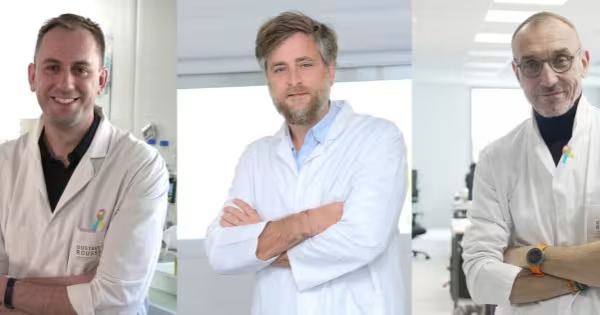
The Gustave Roussy Foundation is launching an ambitious programme of chairs of excellence to attract and retain the world’s leading cancer researchers. Three inaugural chairs are already operational under the leadership of internationally renowned scientists. The ambition is to accelerate breakthroughs in the fight against cancer.
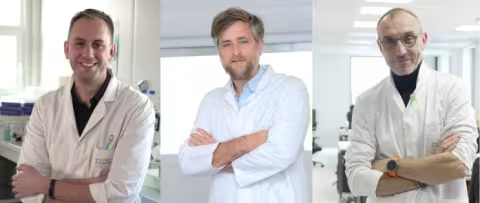
Active for 20 years in fundraising for cancer research, the Gustave Roussy Foundation now hosts Gustave Roussy’s exploratory and translational research and is launching an ambitious programme of chairs of excellence.
The objective is to attract and retain top French and international researchers by providing optimal working conditions and all the necessary resources to explore new therapeutic avenues against cancer.
In the long term, the Foundation aims to recruit 25 high-level researchers. The chairs will be structured around seven major research areas: DNA repair and genome stability, paediatric cancers, data science and artificial intelligence, novel therapies, radiotherapy, metabolism and cancer, and haematology.
Located within the Paris-Saclay Cancer Cluster (PSCC) - an innovation hub in oncology bringing together researchers, clinicians and industry - these chairs benefit from a unique ecosystem conducive to scientific discovery and its translation into tangible therapeutic solutions.
Three Chairs of Excellence Already Operational
Three internationally recognised researchers have already joined the Foundation through its chairs of excellence programme:
- The Natural Killer (NK) Cells Chair, led by Professor Éric Vivier, President of the Paris-Saclay Cancer Cluster, aims to explore the therapeutic potential of these immune cells. NK cells are capable of rapidly identifying and eliminating cancer cells while sparing healthy ones and activating other immune actors such as macrophages and T lymphocytes. This Chair’s ambition is to amplify their antitumour activity and enhance their ability to trigger lymphocyte responses, ultimately leading to the development of new drugs that will unleash the immune response against cancer.
- The Myeloid Cells Chair, under the direction of Professor Florent Ginhoux, a world-renowned expert on macrophages, is dedicated to paediatric cancer, notably diffuse intrinsic pontine gliomas (DIPG), a form of brain tumour with a very poor prognosis. His team has already made a major breakthrough by developing a three-dimensional brain organoid (neural organoid) containing macrophages and modelling the brain’s immune microenvironment. These organoids allow researchers to replicate the development of childhood brain tumours to better understand their mechanisms and identify new therapeutic avenues. The current objective is to reprogramme macrophages - often hijacked by tumours to support their growth - so that they recover their role in defending the body against cancer cells.
- The Nanotherapies Chair, led by Alexandre Detappe, an expert in nanoparticles, focuses on developing innovative targeted drug delivery systems. In response to the toxic side effects of chemotherapy and immunotherapy, which can significantly affect patients’ quality of life, this chair is developing nanoparticles capable of temporarily encapsulating treatments. This technology allows the drug’s activity to be blocked until it reaches the tumour, where it is then released and activated specifically. This precision approach preserves healthy cells while maximising therapeutic efficacy. Alexandre Detappe’s work has already led to 8 patent filings and 24 scientific publications. His team is now working to translate these preclinical advances into clinical trials to validate these novel therapies.
Last news
-
Breast Cancer: Gustave Roussy Ranked No. 1 in France for Breast Surgery and Breast Reconstruction
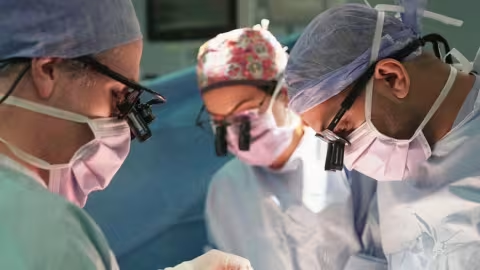
On the occasion of Breast Cancer Awareness Month, the 2025 data from Visuchir, the national surgical activity monitoring tool of the French Health Insurance system, places Gustave Roussy in first position for both breast surgery and breast reconstruction. Beyond this ranking, these figures highlight that reconstruction is now an integral part of breast cancer treatment. It is considered at every stage of care: from tumor removal surgery, whether lumpectomy or mastectomy, through to the post-cancer period, helping to restore the body and support women in regaining their physical integrity and quality of life.
-
Newsweek Ranking: Gustave Roussy Named Europe’s Leading Cancer Centre and Third Best Worldwide
The 2027 edition of Newsweek’s World's Best Specialized Hospitals ranking once again recognises Gustave Roussy as the leading cancer centre in France and Europe, and the third best worldwide. This distinction highlights the excellence of the Institute’s care and research, as well as the daily commitment of all its professionals.
-
Living with and beyond cancer: the promises and challenges of digital health
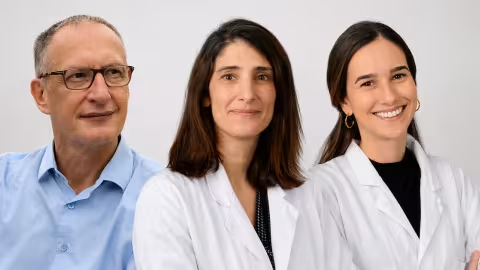
In a Viewpoint article published in The Lancet Digital Health, Drs Ines Vaz-Luis and Maria Alice Franzoi, together with Emmanuel Mussault, a patient partner at the PRISM University Hospital Institute, examine the role that digital tools can play in supporting people living with and beyond cancer. Their central message is that these technologies can support more personalised and accessible care, but their value depends primarily on how they are integrated into care pathways, the human support provided, their ability to address individual needs and their evaluation in real-world settings.
-
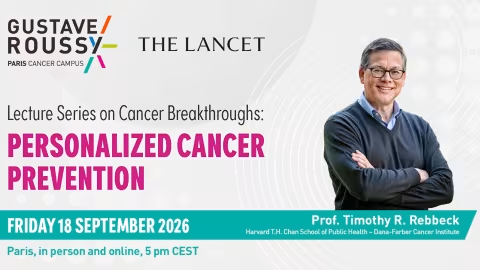
Gustave Roussy and The Lancet launch an international lecture series on innovations transforming cancer care
The inaugural lecture in the “Lecture Series on Cancer Breakthroughs” will take place on Friday 18 September at 5:00 pm. It will be delivered by Professor Timothy R. Rebbeck, a leading cancer prevention specialist at Harvard University and the Dana-Farber Cancer Institute.