Welcome to the new Gustave Roussy website
A new website designed to offer you a simpler, clearer, and more intuitive experience. Patients, caregivers, healthcare professionals, and donors: find information, news, and services more easily.
Gustave Roussy at the AACR 2025 Congress
The American Association for Cancer Research (AACR) annual meeting, held from 25 to 30 April in Chicago, is a major event dedicated to scientific and translational research in oncology. It highlights advances that turn discoveries into tangible clinical applications for patients. Alongside ASCO and ESMO, it is one of the key international congresses in oncology.
Published on
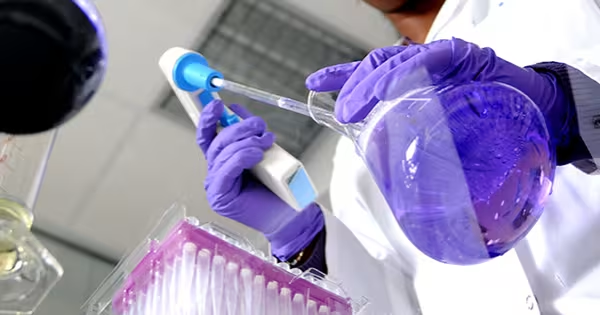
The American Association for Cancer Research (AACR) annual meeting, held from 25 to 30 April in Chicago, is a major event dedicated to scientific and translational research in oncology. It highlights advances that turn discoveries into tangible clinical applications for patients. Alongside ASCO and ESMO, it is one of the key international congresses in oncology.
This year at the AACR congress, physicians and researchers from Gustave Roussy are authors or co-authors of 49 presentations. These include 12 oral presentations (five plenary sessions, six minisymposia and one late-breaking minisymposium), as well as 37 posters.
Among these, five oral presentations will be delivered by Gustave Roussy experts. This strong presence underscores the global significance of the Institute’s fundamental and translational oncology research.
- Roman Chabanon – A new therapeutic pathway for BRCA1/2-mutant cancers
This research demonstrates for the first time that cancer cells carrying BRCA1/2 mutations (as found in some aggressive subtypes of breast, ovarian, prostate and pancreatic cancers) rely on the ADAR1 enzyme for survival. The results presented at the AACR Congress show that inhibiting ADAR1 in BRCA1/2-deficient tumour cells triggers an accumulation of DNA damage, resulting in an autoimmune reaction that is toxic to cancer cells and leads to their destruction. This major discovery opens the door to new targeted treatment strategies for BRCA1/2-mutant cancers using ADAR1 inhibitors or degraders - ADAR1 synthetic lethality in BRCA1/2-mutant tumors defines autocrine interferon poisoning as a targetable vulnerability of cancer cells.
- Simon Thomas – A microbiota-derived metabolite to boost immunotherapy effectiveness
Faecal microbiota transplantation (FMT) from a healthy donor to a cancer patient is a technique currently under investigation to enhance the efficacy of antitumour immunotherapies. In this study, researchers found that certain components of the microbiota enhance treatment effects following FMT, while others do not. The key factor? The presence (or absence) of a metabolite called desaminotyrosine, which plays a role in modulating the immune system. These findings suggest that altering the gut microbiota to increase desaminotyrosine production could represent a new strategy to improve the effectiveness of cancer immunotherapies - Desaminotyrosine contributes to the anticancer effect of fecal microbial transplantation during immune checkpoint blockade in mice and patients.
- Dr Carolina Alves Costa Silva – Better understanding the role of antibiotics on the effectiveness of cancer immunotherapies
Antibiotics can compromise the effectiveness of immunotherapy in cancer patients. However, the exact mechanisms behind these adverse effects remain poorly understood. This study, conducted on 626 patients using a multi-omic approach, reveals that only broad-spectrum antibiotics – those that destroy a wide range of bacteria – worsen clinical outcomes. By disrupting gut microbial communities, these antibiotics reduce microbial diversity and promote the growth of bacteria that may weaken the immune system. Recovery of intestinal health markers took at least 90 days after stopping antibiotics, highlighting the need for microbiota-focused interventions to speed up recovery. Interestingly, some patients responded well to immunotherapy despite antibiotic use, opening new avenues of research to limit side effects and better protect patients undergoing immunotherapy - Multipronged approach identifying new hallmarks of antibiotics-mediated immunosuppression in a prospective trial of cancer immunotherapy.
- Dr. Marine Fidelle – Detecting cancer risk through a blood test
In adults, cancer often arises from cellular changes linked to chronic inflammation and a weakened immune system. To better identify those at risk before disease onset, researchers analysed biological markers in the blood and stool of two high-risk populations: smokers with cardiovascular disease and individuals carrying a genetic mutation that increases cancer risk. The study identified 27 biological markers capable of predicting cancer risk. These markers allow classifying patients into three risk categories, paving the way for more personalised screening programmes. The findings show that a simple blood test could, in future, help identify individuals at high risk of cancer earlier, enabling closer monitoring and earlier intervention - Multiomic functional biomarkers for predicting the transition from inflammation to cancer.
- Dr. Birgit Geoerger – Genomic medicine in childhood and adolescent cancers
The study presented is part of France’s Genomic Medicine 2025 Plan. This national programme aims to integrate high-throughput genome sequencing into cancer care, enabling the analysis of tumour DNA to identify genetic alterations and offer personalised treatments. Since 2020, nearly half of all prescriptions under this programme have concerned paediatric cancers. The results are promising: in 90% of relapse or treatment failure cases, an actionable genetic alteration was identified, and targeted therapy was recommended for 77% of the affected children and adolescents. To ensure continued progress in precision medicine, the MAPPYACTS 2 clinical study, sponsored by Gustave Roussy, has been linked to the programme to track patient outcomes post-sequencing, develop combination therapies and support related research. This programme marks a major step forward towards more personalised care tailored to paediatric cancers - Very high throughput genome sequencing for pediatric cancers in France.
Plenary sessions: Gustave Roussy also represented
Experts from Gustave Roussy are also co-authors of five studies selected for plenary session presentations:
- Dr. Yungan Tao contributed to the Keynote-689 study, which evaluates the addition of pembrolizumab to the standard treatment for squamous cell carcinoma of the head and neck.
- Dr. Sophie Postel-Vinay is the last author of a study evaluating a next-generation inhibitor in humans for the first time, in patients with advanced cancers exhibiting microsatellite instability (MSI).
- Prof. David Planchard took part in the BEAMION-Lung 1 study, which assesses zongertinib, a tyrosine kinase inhibitor, in advanced non-small cell lung cancers with HER2 mutations.
- Dr. Capucine Baldini was involved in a trial evaluating runimotamab, a bispecific T-cell engager antibody, alone or in combination with trastuzumab, in patients with HER2-expressing breast cancer.
- Prof. Aurélien Marabelle collaborated on the START-001 study, which is investigating invikafusp alfa, an innovative bispecific antibody, in patients with antigen-rich solid tumours resistant to anti-PD(L)1 treatments.
In addition, Prof. Fabrice André, Gustave Roussy’s Director of Research, will lead a Meet the Expert session; Prof. Laurence Zitvogel will chair an educational session; and Prof. Caroline Robert will chair a session dedicated to neoadjuvant treatments in solid tumours.
Last news
-
Breast Cancer: Gustave Roussy Ranked No. 1 in France for Breast Surgery and Breast Reconstruction
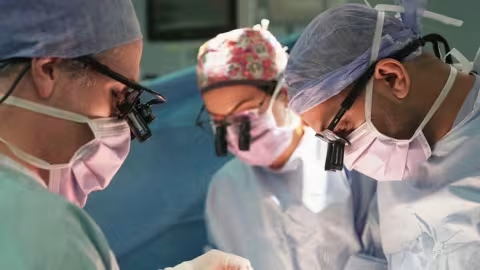
On the occasion of Breast Cancer Awareness Month, the 2025 data from Visuchir, the national surgical activity monitoring tool of the French Health Insurance system, places Gustave Roussy in first position for both breast surgery and breast reconstruction. Beyond this ranking, these figures highlight that reconstruction is now an integral part of breast cancer treatment. It is considered at every stage of care: from tumor removal surgery, whether lumpectomy or mastectomy, through to the post-cancer period, helping to restore the body and support women in regaining their physical integrity and quality of life.
-
Newsweek Ranking: Gustave Roussy Named Europe’s Leading Cancer Centre and Third Best Worldwide
The 2027 edition of Newsweek’s World's Best Specialized Hospitals ranking once again recognises Gustave Roussy as the leading cancer centre in France and Europe, and the third best worldwide. This distinction highlights the excellence of the Institute’s care and research, as well as the daily commitment of all its professionals.
-
Living with and beyond cancer: the promises and challenges of digital health
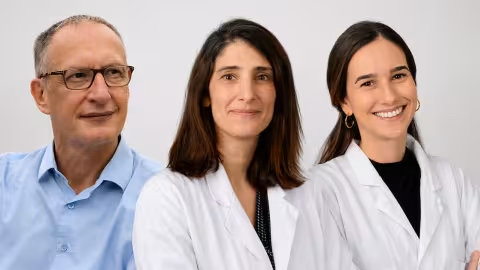
In a Viewpoint article published in The Lancet Digital Health, Drs Ines Vaz-Luis and Maria Alice Franzoi, together with Emmanuel Mussault, a patient partner at the PRISM University Hospital Institute, examine the role that digital tools can play in supporting people living with and beyond cancer. Their central message is that these technologies can support more personalised and accessible care, but their value depends primarily on how they are integrated into care pathways, the human support provided, their ability to address individual needs and their evaluation in real-world settings.
-
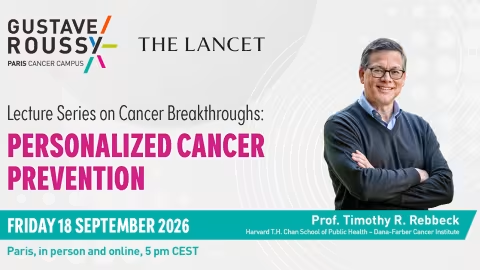
Gustave Roussy and The Lancet launch an international lecture series on innovations transforming cancer care
The inaugural lecture in the “Lecture Series on Cancer Breakthroughs” will take place on Friday 18 September at 5:00 pm. It will be delivered by Professor Timothy R. Rebbeck, a leading cancer prevention specialist at Harvard University and the Dana-Farber Cancer Institute.