Welcome to the new Gustave Roussy website
A new website designed to offer you a simpler, clearer, and more intuitive experience. Patients, caregivers, healthcare professionals, and donors: find information, news, and services more easily.
Personalized Cancer Prevention Takes Center Stage During Clinical Research Week
Scheduled to begin on May 18, this year’s Gustave Roussy Clinical Research Week will focus on personalized cancer prevention and the essential role that clinical research plays in advancing it. Hosted by health journalist Odile Pouget, a dedicated webinar will be held on May 21 at 6:00 p.m., featuring experts from Gustave Roussy.
Published on
Changed on
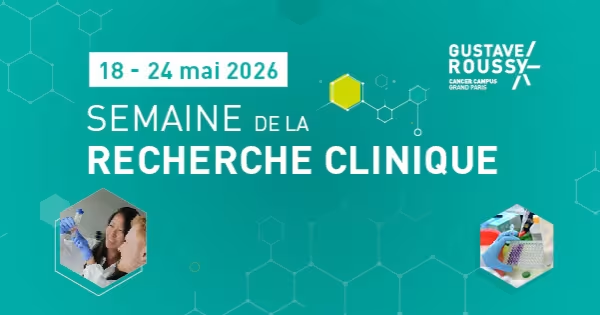
Every year in May, Gustave Roussy takes the opportunity to highlight clinical research, the cornerstone of access to innovation in oncology and essential for the development of new therapies and techniques to fight cancer more effectively.
This year, the various events planned will focus on the theme of personalized cancer prevention. Entitled “Toward Tailored Cancer Prevention: How Research Is Making a Difference,” this year’s event will feature:
- From May 18 to 24, an educational exhibition dedicated to clinical research on the Gustave Roussy outpatient floor.
- Thursday, May 21, at 6:00 p.m.: a webinar open to the general public, featuring experts from Gustave Roussy and moderated by Odile Pouget, a health journalist.
Prevention and Clinical Research
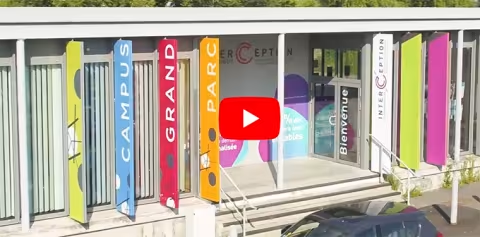
It is estimated that 40% of cancer cases worldwide are linked to modifiable and identifiable risk factors[1]. To address this issue, Gustave Roussy launched the Interception program in 2021, which offers various personalized prevention pathways. The goal? To intervene early with individuals at increased risk (genetic predispositions, tobacco, alcohol, etc.) through tailored support and follow-up, to reduce the risk of developing the disease and, if it does develop, to detect it as early as possible.
With a rise in cancer incidence projected for the coming decades[2], strengthening the role and effectiveness of prevention is becoming a major public health priority. Clinical research plays a fundamental role in meeting these objectives by identifying new predictive biomarkers. These biomarkers are signatures present in the body that can help identify individuals at increased risk of developing cancer years before the disease appears. The LEAH clinical study, led by Gustave Roussy, aims to identify new predictive biomarkers through the Interception program.
Clinical Research at Gustave Roussy
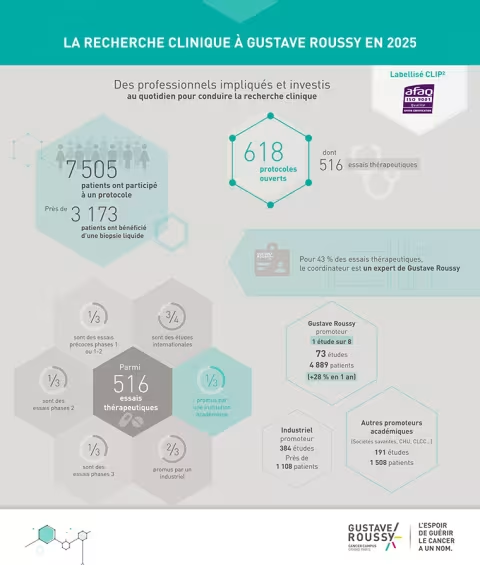
Clinical research is at the heart of Gustave Roussy’s mission. In 2025, 618 studies were underway there, including 516 therapeutic trials.
To better understand the objectives of clinical trials, the different types, how they are designed, or to understand the differences between Phase I, II, and III trials, visit the Gustave Roussy consultation area from May 18 to 24, where an educational exhibition will be held.
► For more information on cancer prevention
► For more information on clinical research
[1] Fink H. et al., “Global and regional cancer burden attributable to modifiable risk factors to inform prevention,” *Nature Medicine*, vol. 32, pp. 1306–1315, 2026.
[2] Force L, Kocarnik J, May M et al. The global, regional, and national burden of cancer, 1990–2023, with forecasts to 2050: a systematic analysis for the Global Burden of Disease Study 2023
The Lancet, 2025; 406, 1565–1586
Last news
-
Breast Cancer: Gustave Roussy Ranked No. 1 in France for Breast Surgery and Breast Reconstruction
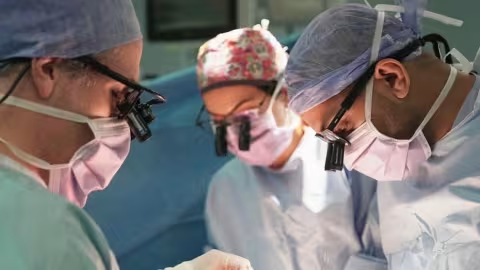
On the occasion of Breast Cancer Awareness Month, the 2025 data from Visuchir, the national surgical activity monitoring tool of the French Health Insurance system, places Gustave Roussy in first position for both breast surgery and breast reconstruction. Beyond this ranking, these figures highlight that reconstruction is now an integral part of breast cancer treatment. It is considered at every stage of care: from tumor removal surgery, whether lumpectomy or mastectomy, through to the post-cancer period, helping to restore the body and support women in regaining their physical integrity and quality of life.
-
Newsweek Ranking: Gustave Roussy Named Europe’s Leading Cancer Centre and Third Best Worldwide
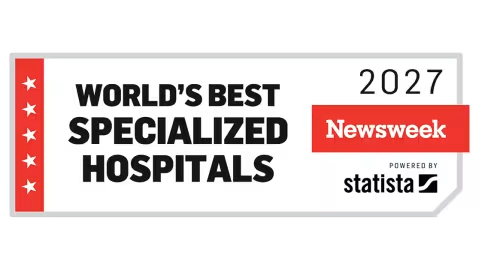
The 2027 edition of Newsweek’s World's Best Specialized Hospitals ranking once again recognises Gustave Roussy as the leading cancer centre in France and Europe, and the third best worldwide. This distinction highlights the excellence of the Institute’s care and research, as well as the daily commitment of all its professionals.
-
Living with and beyond cancer: the promises and challenges of digital health
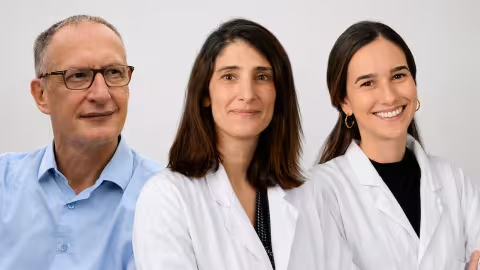
In a Viewpoint article published in The Lancet Digital Health, Drs Ines Vaz-Luis and Maria Alice Franzoi, together with Emmanuel Mussault, a patient partner at the PRISM University Hospital Institute, examine the role that digital tools can play in supporting people living with and beyond cancer. Their central message is that these technologies can support more personalised and accessible care, but their value depends primarily on how they are integrated into care pathways, the human support provided, their ability to address individual needs and their evaluation in real-world settings.
-
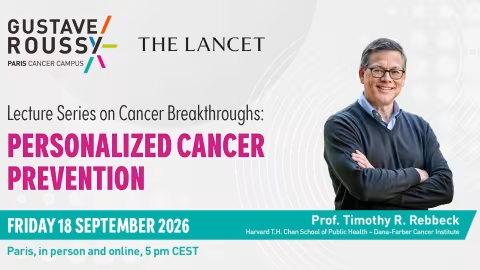
Gustave Roussy and The Lancet launch an international lecture series on innovations transforming cancer care
The inaugural lecture in the “Lecture Series on Cancer Breakthroughs” will take place on Friday 18 September at 5:00 pm. It will be delivered by Professor Timothy R. Rebbeck, a leading cancer prevention specialist at Harvard University and the Dana-Farber Cancer Institute.