
Welcome to the new Gustave Roussy website
A new website designed to offer you a simpler, clearer, and more intuitive experience. Patients, caregivers, healthcare professionals, and donors: find information, news, and services more easily.
Immunotherapy: Therapeutic Vaccines
Over the past decade, the revolution in cancer treatment driven by immunotherapy has led to major advances that benefit patients. Researchers are no longer focused solely on directly attacking cancer cells, as chemotherapy or radiation therapy do, but rather on strengthening the patient’s immune system so that it can eliminate the cancer cells on its own.
This approach opens up new possibilities in the field of therapeutic cancer vaccination. Long viewed as a distant goal, the development of such tools to target cancer cells and prevent relapses is now becoming a reality. At Gustave Roussy, Europe’s leading cancer research center, several clinical trials are underway to evaluate the effectiveness of these new treatments, alongside basic research.
Physician-researchers are focusing primarily on T cells, which are part of our immune system. These cells are capable of killing cancer cells by releasing cytotoxic granules, but are often not present in sufficient quantities or are not effective enough to carry out their mission, and fall victim to the immune evasion mechanisms developed by tumors.
Based on these mechanisms, the principle involves injecting patients with information about the antigens expressed by their cancer cells. This information can be delivered via a peptide vaccine, an mRNA vaccine, or a viral vector vaccine. The goal is to train T cells to recognize the antigens expressed by tumor cells, so that they multiply and attack them en masse. Currently, two approaches are being explored: personalized vaccines, developed in the laboratory for each patient, and generic vaccines, which target common antigens expressed by a specific group of patients identified in advance. In most cases, a more traditional form of immunotherapy—based on the activation of immune checkpoints—will be administered as a complementary treatment.
Principle
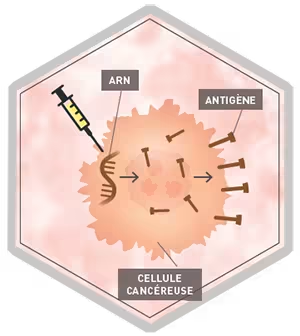
Training the patient’s immune cells to better recognize cancer cells, so that they multiply in their presence and attack them.
Example
The patient is injected with messenger RNAs that correspond to the antigens on their cancer cells. Once in the body, these RNAs are translated into proteins, leading to the production of immune cells specifically designed to attack the cancer cells.
Clinical Research
At Gustave Roussy, where one-quarter of the 50,000 patients treated each year participate in a clinical trial, several studies are underway to assess the efficacy of new therapeutic vaccine candidates.
- The mRNA-4157 vaccine from Moderna, Inc. and Merck. This vaccine candidate is being evaluated in a Phase III trial at the Institute. “This is a personalized vaccination approach, with a clinical trial open to patients who have undergone surgery for melanoma. Using a tumor sample, the laboratory will identify new mutations that have emerged in the body—known as neoantigens. The vaccine will then be manufactured fairly quickly—within 6 to 8 weeks—to produce an RNA sequence that encodes the targeted antigens. The immune system will recognize and target them. “The clinical trial began in late 2023 at Gustave Roussy and involves about ten patients from the Institute,” explains Prof. Caroline Robert, head of the Dermatology Department at Gustave Roussy. In the Phase IIB trial, among the 107 patients who received the combination of the vaccine and immunotherapy, a 44% reduction in the risk of recurrence or death was observed compared to patients who received immunotherapy alone.
- The IO102-IO103 vaccine, developed by IOBIOTECH, is a vaccine against metastatic melanoma that is also being evaluated in a Phase III trial at the Institute. It is designed to activate and expand T cells specific to the IDO enzyme and the PD-L1 protein, which are overexpressed in many types of solid tumors and immunosuppressive cells. When combined with nivolumab, an anti-PD-1 immunotherapy, this vaccine has shown initial encouraging results in Phase I and II trials.
- The Tedopi vaccine from Ose Immunotherapeutics. A first Phase III clinical trial was coordinated by Prof. Benjamin Besse to evaluate this treatment for patients with non-small cell lung cancer. “It’s a protein-based vaccine that targets five proteins of interest in the context of lung cancer. The goal is to train the immune system to recognize these proteins. “We found that, among all patients, the vaccine does not perform better than chemotherapy. However, in the subgroup of patients who benefited from immunotherapy, we observed a benefit from the vaccine,” he explains. A new Phase III trial, ARTEMIA, is currently recruiting participants, still coordinated by Prof. Benjamin Besse. This time, it aims to evaluate the efficacy of Tedopi exclusively in a subpopulation of patients who respond to immunotherapy.
Another clinical trial is underway to assess the efficacy of Tedopi in ovarian cancers. The Tedova study is coordinated by Dr. Alexandra Leary, a medical oncologist at Gustave Roussy. - Enterome’s EO2401 vaccine. This vaccine is intended for patients with locally advanced or metastatic adrenocortical carcinoma or malignant pheochromocytoma/paraganglioma. Dr. Éric Baudin is the principal investigator of the Spencer study, which aims to evaluate EO2401. This is a peptide vaccine that targets three antigens expressed by adrenal tumor cells, with the goal of eliciting an immune response. Initial interim results have shown more than encouraging outcomes.
Basic Research
[Notes: Section to be revised based on new teams/units]
At Gustave Roussy, where research with a significant societal impact plays a major role, researchers are working to develop therapeutic vaccines to fight cancer.
- Dr. Sébastien Apcher leads the “Unconventional Epitopes and Anti-Cancer Immune Response” team, which is part of UMR 1015 “Tumor Immunology and Cancer Immunotherapy.” The initial goal is to develop a vaccine against colon and pancreatic cancer.
The research builds on advances in cancer vaccination, focusing on antigens expressed by cancer cells to elicit an immune response in patients.
The uniqueness of this vaccine lies in the type of epitope—the part of the antigen that triggers an immune response—injected into the patient. Dr. Apcher and his team have successfully demonstrated the immunogenic role of certain unconventional epitopes that they identified on the surface of tumor cells.
Analysis of tumors from several patients revealed 20 common unconventional epitopes, some of which are capable of triggering a robust immune response. Among these epitopes, some—found in patients with colon cancer—have been shown to induce an immune response in patients with colon and pancreatic cancers. This finding suggests that certain epitopes found in patients with colon cancer could also be targeted in patients with pancreatic cancer.
Initial in vivo trials have shown that vaccination with unconventional epitopes can induce specific T-cell activation and inhibit tumor growth. Dr. Apcher and his team are currently continuing their research to build on their work with unconventional epitopes. A patent will soon be filed, with the goal of testing the vaccine on colon and pancreatic organoids. Ultimately, he plans to transition from a peptide vaccine to an mRNA vaccine.
- Dr. Fathia Mami-Chouaib heads UMR 1186 (Gustave Roussy/Inserm/Université Paris-Saclay Joint Research Unit), “Integrative Tumor Immunology and Cancer Immunotherapy.” The UMR’s primary research focus is on developing a vaccine against lung cancer, supported by a Gustave Roussy spin-off, the startup ElyssaMed. “We are using PPCT, which is a tumor antigen. Our goal is to vaccinate the patient with this antigen to activate lymphocytes specifically targeted at destroying the tumor. Very often, patients have these lymphocytes, but in too small a number. This vaccination will activate the lymphocytes, forcing them to multiply,” explains Dr. Fathia Mami-Chouaib.
Her laboratory has already demonstrated the vaccine’s efficacy in vitro and in vivo. All preclinical work has been completed, and initial discussions with clinicians at the Institute have taken place. The research project received the Grand Prix de l’Innovation from the City of Paris, as well as the i-Lab innovation competition organized by BPI France and the French Tech Emergence grant
.”“What’s interesting about our vaccine is that it targets tumor cells that have tried to evade the immune system,” continues Fathia Mami-Chouaib. “Our antigen is modified through an alternative pathway, different from the conventional one. It therefore allows us to target tumor cells that have made themselves invisible.”