
Welcome to the new Gustave Roussy website
A new website designed to offer you a simpler, clearer, and more intuitive experience. Patients, caregivers, healthcare professionals, and donors: find information, news, and services more easily.
Marc Deloger, a pioneer in bioinformatics dedicated to advancing cancer research
Our Experts Speak
Marc Deloger
a Pioneer in Bioinformatics Driving Advances in Cancer Research
At the intersection of biology, computer science, and mathematics, bioinformatics is a discipline that emerged in the 2000s. “Our field can be applied to both theoretical and applied research,” explains Marc Deloger, who joined Gustave Roussy ten years ago as a postdoctoral fellow in the bioinformatics platform. He became its director in January 2020.
Three Key Areas of Activity for the Benefit of Patients
The bioinformatics platform has three main missions:
- Analyzing sequencing data (DNA, RNA, and genetic profiles of patients’ tumors).
- Organizing and leveraging data from Gustave Roussy patients.
- Training, teaching, and supporting researchers, clinicians, and doctoral students… to respond quickly and effectively to their questions by leveraging the power of computational tools, thereby accelerating research.
Marc Deloger leads these efforts by working closely with the hospital and research units. He particularly values “being able to generate new knowledge by collaborating with researchers and other professionals on various types of tumors and a wide range of challenges.”
A High-Performance Platform
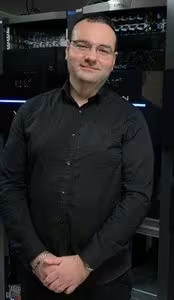
The platform is, first and foremost, a massive server located in an air-conditioned room. “Thanks to our sponsor, Dell, we have access to high-performance, cutting-edge technology. This is essential because, over the past three years, requests for analysis have been increasing by 20% annually.”
Seven engineers (analysts, data managers, and developers) work at the platform. “Research teams recruit their own bioinformaticians: doctoral students, postdocs, interns, engineers… Our role is to create a true bioinformatics community so that people aren’t working in isolation and can benefit from the diverse expertise available at Gustave Roussy.”
Versatility and Adaptability
Every week, Marc Deloger reviews ongoing projects and potential roadblocks. He responds to various requests from management, researchers, and members of the bioinformatics community: “Funding requests raise questions about data: where should it be stored? How? Who will have access to it?”
The manager appreciates “staying focused on the technical side, because in our highly innovative field, a new technology emerges every six months, and we have to adapt to it.”
Marc Deloger is co-director of the Data Science medical-scientific program, which aims to “ensure that Gustave Roussy can structure high-quality patient data so that it is ready for use in new data analysis activities such as artificial intelligence.”
Healthcare Data: A Gold Mine Waiting to Be Tapped
With more than 400,000 patients treated over the past 20 years, Gustave Roussy—the largest clinical trial recruitment center—generates a vast amount of data. Since each department has its own databases, the bioinformatics team created connectors between the systems this year, making it easier to run queries through a single portal.
Another challenge is ensuring the interoperability of data systems on a national scale through Unicancer and the Paris-Saclay Cancer Cluster, and at the European level with Cancer Core Europe. "The goal is to coordinate the efforts of the largest cancer centers to create a shared portal that makes it easy to set up multicenter trials."
A Field with a Bright Future
Bioinformatics is undoubtedly a profession with a bright future. “Every year, more biologists train with us in data analysis: this makes it easier to publish findings and secure funding. Identifying a common mutation can signal a new biomarker or a new target. Our work thus helps accelerate research.”