Welcome to the new Gustave Roussy website
A new website designed to offer you a simpler, clearer, and more intuitive experience. Patients, caregivers, healthcare professionals, and donors: find information, news, and services more easily.
Patient Testimonials - Tommy
Patient Testimonials
Tommy,
Wyatt’s Father, in Remission Since 2022

In February 2020, as we were returning from a ski trip, my 5-year-old son, Wyatt, complained of severe pain in his jaw.
We went straight to Henri Mondor Hospital, where he was put on antibiotics and told that his jaw was fractured. The diagnosis seemed incomprehensible to us because we couldn’t have missed such a fracture, and Wyatt hadn’t been hit.
After a week on antibiotics, the pain hadn’t improved, and we were told that surgery on his jaw might be necessary. That was out of the question for us—we didn’t want to operate on our son without knowing and understanding what was wrong with him.
We then reached out to Necker Hospital, which specializes in pediatrics. They performed an MRI, and shortly afterward, they told us that our son had Burkitt’s lymphoma, a tumor known to be quite aggressive. They performed a biopsy, and very quickly we were transferred to Gustave Roussy, where we met with Professor Minard Collin, a specialist in Burkitt lymphoma, as well as Dr. Rigaud.
We started chemotherapy very quickly and went through a series of treatment cycles before realizing that our son was chemotherapy-resistant. This meant that time had clearly become our enemy. We had a 21-day window before the tumor would start progressing again. We then considered possible bone marrow transplants, but time was working against us, and the 21-day window didn’t allow us to pursue that option.
In May 2020, we were offered the chance to try CAR T-cell therapy; we had Wyatt’s blood drawn, which was then sent to the U.S. to be processed. It’s a lengthy process. At the same time, we continued with chemotherapy. CAR T-cell therapy doesn’t work when the disease is progressing; it only works when the disease is in remission. It’s a race against the clock, with everything hinging on that 21-day window of opportunity. We then began radiation therapy, which went very poorly. We underwent a series of tests to qualify for the CAR T-cell infusion, which was scheduled to begin in early August, but the disease started progressing again. The question then arose of whether to go ahead with it or not; there was a lot of back-and-forth, and finally, in August 2020, we began the CAR T-cell treatment at Robert Debré Hospital with Prof. Baruchel.
It’s important to understand that this is a very grueling process. My son spent a week in the intensive care unit, with a raging fever, sedated and intubated. He had a mass in his throat that prevented him from breathing properly.
My son is full of determination and a positive attitude. I think the patient’s mindset plays a huge role in this type of illness. After a week, the results showed some positive signs, despite Wyatt being extremely fatigued. We were transferred back to Gustave Roussy.
We then considered surgery to remove what remained of the tumor, but the disease began to progress again. The surgery went very badly; the surgeons told us that everything was stuck together and that they couldn’t work miracles.
We asked for another round of chemotherapy, but we were told it no longer made sense—that we’d tried everything and that it was over!
But my son kept believing, kept looking toward the future, and stayed positive!
We called everywhere to find a solution for Wyatt, read everything we could find, and eventually called a hospital in Switzerland. Time was running out!
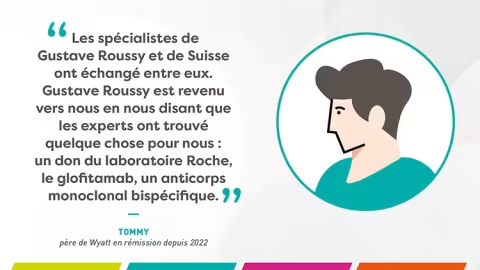
This hospital is willing to admit Wyatt, while also telling us that Gustave Roussy is the best hospital in Europe. Specialists at Gustave Roussy and in Switzerland consulted with one another, and Gustave Roussy got back to us, saying they might have found something for us: a donation from Roche Laboratories—glofitamab, a bispecific monoclonal antibody.
This antibody was combined with monthly immunotherapy, which he received from October 2020 through October 2021. It was this antibody, along with the immunotherapy, that helped boost the CAR T-cell response. Since then, we’ve seen a complete response, and Wyatt was declared in remission in early 2022. The trade-off? Wyatt no longer has any B cells, so he must receive a monthly immunoglobulin injection. But we’re putting things into perspective—Wyatt is in remission. It’s a relief for our whole family; our lives had been on hold. But we’re moving forward with caution. We’ve learned that time is both our best friend and our worst enemy.
Today Wyatt is doing great; he’s full of joy and strength. He’s in third grade and plays sports. Of course, it’s left its mark—it’s the story of his life—and it’s affected the family, especially his two older sisters, but this little guy is a trooper! Today he still has a few scars, but he’s almost fully recovered thanks to physical therapy.
We’re, of course, very grateful to Gustave Roussy; luck certainly played a part, but they saved our son!
A child’s life is priceless; no child deserves to go through the ordeal of illness. We must give without hesitation. Because giving means hope—hope for the children, hope for the parents—and hope makes dreams come true.
