Welcome to the new Gustave Roussy website
A new website designed to offer you a simpler, clearer, and more intuitive experience. Patients, caregivers, healthcare professionals, and donors: find information, news, and services more easily.
Different Perspectives on the Role of an Advanced Practice Nurse with Delphine Mathivon and Julie Mistiaen
Perspectives on the Role of Advanced Practice Nurses with Delphine Mathivon and Julie Mistiaen
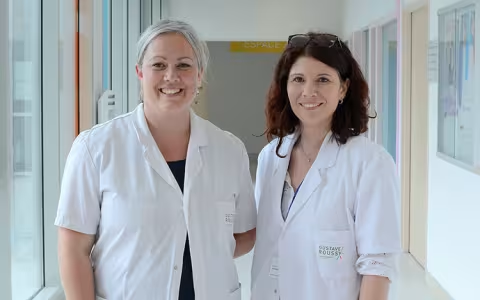
Both embody a new role pioneered at Gustave Roussy: advanced practice nurse (APN) in oncology. We spoke with Delphine Mathivon, APN specializing in toxicity, and Julie Mistiaen, APN specializing in pain management.
Delphine Mathivon and Julie Mistiaen are two nurses with extensive professional backgrounds who chose to specialize in oncology and, for that reason, selected the excellence of Gustave Roussy.
After gaining experience in medical oncology at Gustave Roussy and then in an outpatient clinic, Delphine Mathivon joined the outpatient care coordination team responsible for patients returning home with complex care needs. She then joined the Capri clinical trial, which demonstrated the added value of nursing follow-up for patients on oral therapy. “The dual focus on clinical practice and research is very stimulating and inspired me to apply for the Master’s in Advanced Practice.” Delphine Mathivon was selected, along with Julie Mistiaen, to pursue this new two-year degree program, which is open to nurses with at least three years of professional experience.
As a Pain Resource Nurse at the Pain Assessment and Treatment Center at Gustave Roussy, Julie Mistiaen joined the team in 2010 after beginning her career in neurosurgical intensive care at Lariboisière Hospital in Paris. Specializing in cancer pain management, Julie Mistiaen began her training in 2020 as part of what was then a team project “that later became an initiative for the entire institution.”
“Everything to be built”
The advanced practice nurse possesses a broad range of skills and participates in the comprehensive care of patients whose follow-up is entrusted to her by a physician. For Julie Mistiaen, the role encompasses “clinical expertise and a research focus that elevates the nursing profession, with a leadership role to share best practices and new developments.” The APN practices an innovative form of interprofessional collaboration comprising several components, including therapeutic education and city-hospital coordination. However, “although the avenues and the desire are there, everything still needs to be built from the ground up.”
On a daily basis, Julie Mistiaen sees patients referred by doctors on the pain management team for independent follow-up consultations. She refers them to various medical and paramedical professionals based on their needs. She also trains paramedical staff within the hospital with the help of her colleagues—the Pain Resource Nurses—and is actively involved in the work carried out by Gustave Roussy’s Paramedical Research Commission (Corepa).
Delphine Mathivon meets with patients referred by the Institute’s oncologists during a day hospital session focused on treatment-related toxicity. “After reviewing the patient’s medical history, background, and lifestyle with them to determine what might have triggered the toxicity, the doctor makes the diagnosis and initiates treatment. Patients then have a consultation with a pharmacist at Gustave Roussy. As for me, I monitor them until the toxicity has resolved.” Leading training sessions and research projects on toxicity are also part of her daily routine, along with a therapeutic education component that is still being developed to design workshops for treatment initiation, as well as tools for treatment monitoring.
Diligence and Organization
Both agree: being an IPA requires flexibility and adaptability to handle all aspects of the job: “Above all, it’s about wanting to build a relationship with the patient while also being able to work independently, with great rigor in both clinical practice and research. You have to be organized and, of course, enjoy a challenge.”
Innovative and unconventional, these first two IPA career paths at Gustave Roussy stem from a need on the ground. “The IPA offers an approach that complements that of the physician because we perceive the patient differently,” explains Delphine Mathivon. “It’s nursing expertise that, when combined with medical care, enables comprehensive patient care with a different time allocation.” The next challenge? “Advancing paramedical research to reach the level of our European neighbors,” explains Delphine Mathivon. For Julie Mistiaen, it would be to “highlight the full range of nursing expertise and resources across the Institute’s various departments.” “Proud to contribute to this new endeavor,” both feel strongly supported in their new roles and hope to continue driving projects that bring about positive change.