
Welcome to the new Gustave Roussy website
A new website designed to offer you a simpler, clearer, and more intuitive experience. Patients, caregivers, healthcare professionals, and donors: find information, news, and services more easily.
Age-related genetic changes in the blood associated with poor cancer
On
Changed on
25 april 2025
Age-related genetic changes in the blood associated with poor cancer prognosis
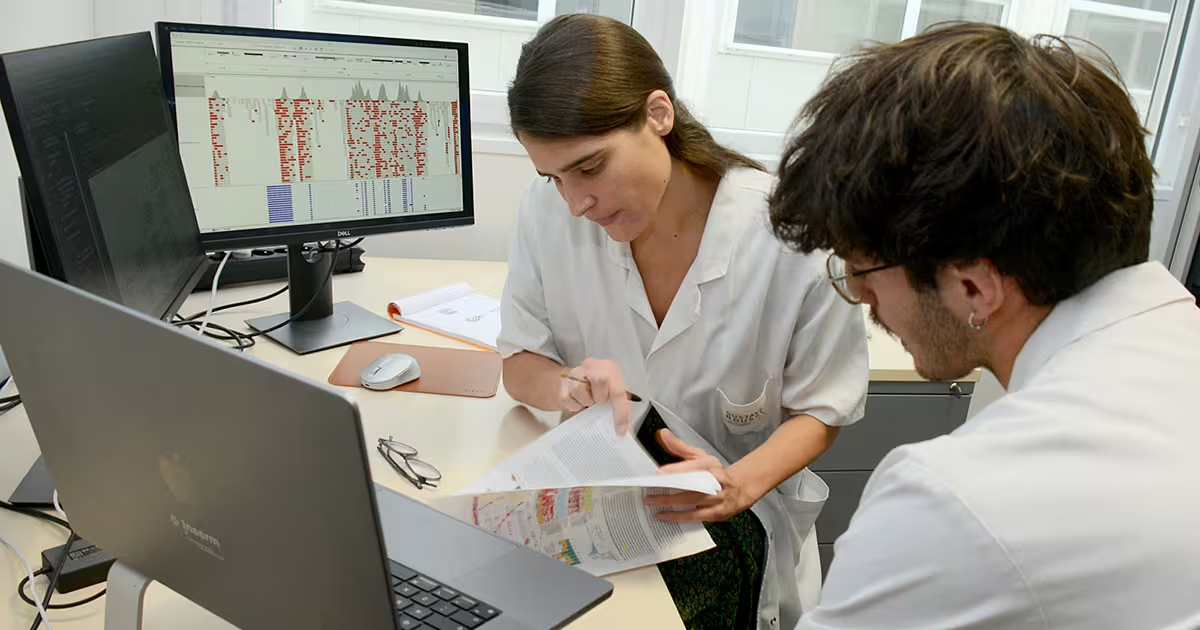
Researchers from the Francis Crick Institute, UCL, Gustave Roussy and Memorial Sloan Kettering Cancer Center (MSK), have discovered that expansion of mutant blood cells, a phenomenon linked to ageing, can be found in cancerous tumours, and this is associated with worse outcomes for patients.
Understanding the biological interface of age-related genetic changes and diseases of ageing, such as cancer and cardiovascular disease, is important to develop preventative therapies for a growing proportion of the population.
Clonal haematopoiesis of indeterminate potential (CHIP) is a condition where blood stem cells accumulate mutations over time, influenced by both ageing and external environmental factors. CHIP has already been shown to be associated with risk of age-related disorders, such as cardiovascular disease, but the impact of these genetic changes on solid cancer evolution hasn’t been thoroughly investigated.
Work published today in the New England Journal of Medicine, is a detailed study of the link between CHIP and cancer, in over 400 patients with lung cancer as part of the Cancer Research UK funded TRACERx and PEACE studies, and 49,000 patients with different types of cancer from MSK.
CHIP and cancer prognosis
An initial examination of blood samples allowed the research team to determine which patients had CHIP mutations in their blood. When matched with clinical data, the scientists observed that these mutations were associated with patients living for a shorter period of time, regardless of their age or the stage at which the cancer was diagnosed.
The researchers then went on to study patients with CHIP in more detail and determine whether the specific mutations were also present in their lung tumours because of blood cell infiltration. This was found to be true in 42% of patients with CHIP and they called this phenomenon tumour infiltrating clonal haematopoiesis (TI-CH). The team found that it was TI-CH, not CHIP alone, that was associated with the greater risk of cancer relapse and cancer death.
This finding was supported by samples from the PEACE study, a postmortem investigation of areas where cancer has spread, the main cause of cancer death. The team found that metastatic tumours at these sites often contained TI-CH mutations.
Not all mutations are equal
To inspect the link between TI-CH and poor patient outcomes, the scientists went on to look at the composition of cells in the lung tumours. They found that patients with TI-CH had an expansion of myeloid cells, a type of immune cell. These cells are an important part of the tumour microenvironment and unlike some immune cells that are primed to recognise and fight cancer, myeloid cells have been shown to regulate inflammation and can support tumour progression and spread.
The researchers also discovered that when mutations affected a gene called TET2, which is an important regulator of blood cell production, across thousands of individuals, the TET2 mutant blood cells were more likely to infiltrate the tumour. When analysing hundreds of single cells from the tumours of two patients with TI-CH, they confirmed that TET2 mutations were mostly present in myeloid cells but not in other immune cell types.
The team then collaborated with blood cancer and CHIP experts in a Crick lab led by Dominique Bonnet, to study the impact of TET2 mutations experimentally. Together they grew organoids, mini lung tumours, with TET2 mutant myeloid cells. They showed that TET2 mutant myeloid cells remodelled the tumour microenvironment and accelerated tumour organoid growth.
Looking beyond lung cancer
Finally, in collaboration with researchers at Memorial Sloan Kettering Cancer Center in the US, the team validated their findings using a much larger data set of over 49,000 patients with different types of cancer. Overall, the presence of TI-CH was an independent predictor of shorter survival. But the presence of CHIP and TI-CH varied between cancer types. Researchers found these mutations were more common in cancers known to be harder to treat like lung cancer, head and neck cancer and pancreatic cancer.
The next steps for this work will be to confirm that CHIP directly contributes to cancer outcomes and then detail the exact mechanism by which CHIP is functionally implicated in the development of aggressive cancers.
This work was led by Oriol Pich, Elsa Bernard and Maria Zagorulya.
Oriol Pich, Postdoctoral Project Research Scientist in the Crick’s Cancer Evolution and Genome Instability Laboratory, said: “Our results show that blood cells carrying age-related mutations can infiltrate tumours and impact cancer evolution, leading to worse outcomes for patients.
“This is important because CHIP is a natural phenomenon of ageing that is common in patients with cancer.”
Elsa Bernard, Group Leader at Gustave Roussy and co-first author of the study, explains: “Through the integrated analysis of large-scale genomic data and cellular profiling, we uncovered a previously unrecognized interaction between hematopoietic aging and tumor evolution. These findings pave the way for new predictive approaches to assess the risk of cancer relapse or progression.”
Charlie Swanton, Deputy Clinical Director at the Crick, Chief Clinician at Cancer Research UK and Chief Investigator for TRACERx, said: “This is the first time that we’ve been able to see at scale, the interaction of two different types of ‘clonal proliferations’, age-related CHIP and cancer, providing insight into how ageing might impact cancer risk.
“As we start to piece together the picture of the most important mutations which evolve during the ageing process in cells from the bone marrow, and the impact they have in disease, we hope we can start to identify opportunities for intervention and maybe even prevention of some age-related cancers.”
For further information:
- The Francis Crick Institute. Contact : press@crick.ac.uk or +44 (0)20 3796 5252
- Gustave Roussy. Contact : claire.parisel@gustaveroussy.fr or + 33 42 11 50 59
Notes to Editors
Reference: Pich, O. et al. (2025). Tumor-Infiltrating Clonal Hematopoiesis. New England Journal of Medicine. DOI: 10.1056/NEJMoa2413361.
pr-chip-nejm-250425.pdf
Press contact
If you are a journalist and have a question, please contact:
Claire Parisel or Léona Pinto
Tel. +33 1 42 11 50 59
Tel. +33 1 42 11 63 59
Mob. +33 6 17 66 00 26
Email
The Media Team cannot respond to patient inquiries.
Last press releases
-
Gold september: two new research programmes launched to tackle childhood cancers
Two of Gustave Roussy’s four new medical and scientific programmes are dedicated to childhood cancers. The first, DECRIPT, aims to improve understanding of the role played by genetics in the development of certain childhood cancers, as well as second cancers that may occur in adulthood. The second, INSPIRE, will draw on the knowledge and techniques already developed at the Institute to create organoids, with the aim of deciphering the mechanisms underlying metastasis and resistance to treatment.

-
Prof. Fabrice Barlesi reappointed at the head of Gustave Roussy, the leading cancer center in France and Europe
By order of Ms. Stéphanie Rist, Minister of Health, Families, Autonomy and Persons with Disabilities, dated 27 July 2026, Professor Fabrice Barlesi has been reappointed as Director General of Gustave Roussy, effective 1 August 2026. At the helm of the Institute for five more years, Prof. Barlesi will continue the transformations undertaken during his first term. This renewal reflects the confidence placed in the project led by the institution to accelerate progress in the fight against cancer, foster and support the development of innovations set to change the future of oncology, and strengthen the influence of one of the world's leading cancer centers.
-
Route du Rhum 2026 Jean Le Cam and Christophe Rateau to sail for Gustave Roussy
For the Route du Rhum - Destination Guadeloupe 2026, Jean Le Cam and Christophe Rateau will sail under the colors of Gustave Roussy, the leading cancer center in France and Europe. Competing respectively in the Vintage and Class40 categories, the two skippers will carry the Institute's mission to the general public, supporting cancer research and raising awareness of prevention, innovation and patient care.

-
Owkin and Gustave Roussy partner to bring K Pro into real-world clinical practice
Owkin and Gustave Roussy, Europe's leading cancer center, today announced a partnership to test K Pro directly within the hospital's real-world clinical and research workflows.