
Welcome to the new Gustave Roussy website
A new website designed to offer you a simpler, clearer, and more intuitive experience. Patients, caregivers, healthcare professionals, and donors: find information, news, and services more easily.
ESMO 2025 - When the tumour microenvironment hinders the effectiveness of Car-T cell therapies
On
Changed on
ESMO 2025 – Proffered paper session
Villejuif, 19 October 2025
When the tumour microenvironment hinders the effectiveness of Car-T cell therapies
Researchers from Gustave Roussy and CentraleSupélec have analysed dozens of biopsies from patients with diffuse large B-cell lymphoma treated with CAR-T cells, to understand why about half of them relapse within weeks after receiving this innovative therapy. This study highlights the role played by the tumour microenvironment in the development of resistance mechanisms against CAR-T cells, paving the way for new therapeutic strategies to overcome this challenge.
Abstract no. LBA47, presented orally by Myriam Ben Khelil on Sunday 19 October at 3:30 pm.
This oral presentation is among the 60 studies on the programme for the 2025 edition of ESMO presented by a physician-researcher from Gustave Roussy. Gustave Roussy is active in numerous fields of expertise, reflecting the quality of the research conducted there and its international recognition.
CAR-T cell therapies have transformed the management of many haematological cancers and are currently being developed for solid tumours. This immunotherapy approach mobilises the patient’s own immune system to fight cancer by collecting T lymphocytes, white blood cells that play a key role in immune defence and can destroy tumour cells.
Once collected, the T cells are reprogrammed in the laboratory to recognise cancer cells via a specific receptor called CAR (Chimeric Antigen Receptor). When reinfused into the patient, these modified cells multiply and migrate towards the tumour to destroy it, even when the cancer attempts to evade the immune system.
Diffuse large B-cell lymphoma (DLBCL) is a cancer of the immune system that develops from B lymphocytes, the cells responsible for producing antibodies. It is the sixth most common cancer and the ninth leading cause of cancer death in Western countries. CAR-T cell therapy is mainly used to treat DLBCL patients who relapse after chemotherapy.
Although nearly 50% of patients benefit from this therapeutic approach and achieve a complete response, the remaining half relapse within months. The study presented at ESMO by Myriam Ben Khelil, research engineer at Gustave Roussy, aims to better understand the resistance mechanisms responsible for these relapses, in order to make CAR-T cell therapies more effective for a larger number of patients.
Advanced analytical techniques
To decipher these resistance mechanisms, researchers from Gustave Roussy and CentraleSupélec analysed 80 tumour samples from 55 patients with diffuse large B-cell lymphoma treated with anti-CD19 CAR-T cells. Samples were collected at three distinct time points: before treatment, immediately after treatment, and at the time of relapse. By combining advanced analytical tools (immunohistochemistry, flow cytometry, spatial transcriptomics and single-cell sequencing) the team was able to reconstruct the precise dynamics of the immune response. All biopsies were performed with the support of Gustave Roussy’s interventional radiology department.
The findings show that CAR-T cell resistance is not due to poor infiltration of the modified cells into the tumour, as they were clearly present after injection, even in patients who did not respond to treatment.
The researchers also found that in some cases, relapse was due to loss of expression of the target antigen on tumour cells. However, this situation was relatively rare (around 15% of relapses), suggesting that target loss is not the main resistance mechanism.
The role of the tumour microenvironment
The tumour microenvironment comprises a vast network of cells and tissues in more or less close contact with tumour cells. Its composition and activity can influence disease progression.
The study reveals that in non-responder patients, CAR-T cells become dysfunctional as early as seven days after infusion. They exhaust more rapidly and lose their ability to attack tumour cells. These alterations are strongly influenced by the tumour microenvironment, which exerts an immunosuppressive effect.
The researchers identified a specific population of myeloid cells, notably tumour-associated macrophages (TAMs) expressing the proteins CSF1R and TREM2, within the tumour microenvironment. These cells are more abundant at diagnosis in resistant patients, and their proximity to CAR-T cells appears to promote loss of therapeutic efficacy. The presence of this macrophage population could, serve, in the future, as a predictive marker of non-response to CAR-T therapy.
Myeloid cells form a large family of immune cells that normally play a crucial role in recognising and destroying foreign cells, as well as regulating immune responses, including against cancer cells.
“This study illustrates the power of cross-disciplinary approaches. Our results show that half of patients fail to respond to CAR-T cells not because these cells cannot reach the tumour, but because they are neutralised locally by the tumour environment. Understanding these mechanisms opens the way to combination treatments that could restore the full potency of CAR-T therapy,” explains Myriam Ben Khelil, research engineer at Gustave Roussy.
“By better understanding how the tumour environment influences CAR-T cell efficacy, we are taking an important step towards more personalised treatments. If we can identify in advance the patients unlikely to respond, it may become possible to combine CAR-T therapy with macrophage-targeting agents to improve efficacy. Ultimately, the goal is to tailor each therapy to the patient’s immune profile, to restore the full potential of CAR-T treatment,” concludes Dr Camille Bigenwald, onco-haematologist at Gustave Roussy and senior author of the study.
Abstract n°LBA47
CAR T cell resistance in high-grade B-cell lymphoma is dictated by tumor-associated macrophages.
Proffered paper session présentée par Myriam Ben Khelil.
Dimanche 18 octobre 2025 | 15h30.
Press contact
If you are a journalist and have a question, please contact:
Claire Parisel or Léona Pinto
Tel. +33 1 42 11 50 59
Tel. +33 1 42 11 63 59
Mob. +33 6 17 66 00 26
Email
The Media Team cannot respond to patient inquiries.
Last press releases
-
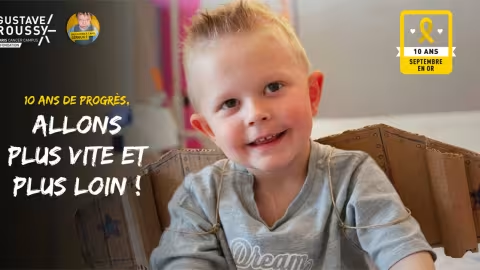
Gold september: two new research programmes launched to tackle childhood cancers
Two of Gustave Roussy’s four new medical and scientific programmes are dedicated to childhood cancers. The first, DECRIPT, aims to improve understanding of the role played by genetics in the development of certain childhood cancers, as well as second cancers that may occur in adulthood. The second, INSPIRE, will draw on the knowledge and techniques already developed at the Institute to create organoids, with the aim of deciphering the mechanisms underlying metastasis and resistance to treatment.
-
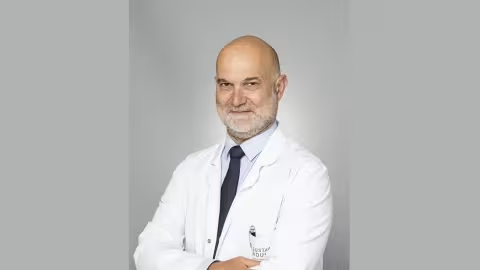
Prof. Fabrice Barlesi reappointed at the head of Gustave Roussy, the leading cancer center in France and Europe
By order of Ms. Stéphanie Rist, Minister of Health, Families, Autonomy and Persons with Disabilities, dated 27 July 2026, Professor Fabrice Barlesi has been reappointed as Director General of Gustave Roussy, effective 1 August 2026. At the helm of the Institute for five more years, Prof. Barlesi will continue the transformations undertaken during his first term. This renewal reflects the confidence placed in the project led by the institution to accelerate progress in the fight against cancer, foster and support the development of innovations set to change the future of oncology, and strengthen the influence of one of the world's leading cancer centers.
-
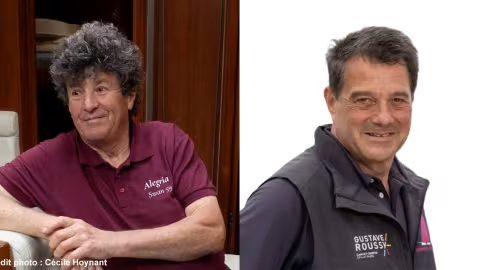
Route du Rhum 2026 Jean Le Cam and Christophe Rateau to sail for Gustave Roussy
For the Route du Rhum - Destination Guadeloupe 2026, Jean Le Cam and Christophe Rateau will sail under the colors of Gustave Roussy, the leading cancer center in France and Europe. Competing respectively in the Vintage and Class40 categories, the two skippers will carry the Institute's mission to the general public, supporting cancer research and raising awareness of prevention, innovation and patient care.
-
Owkin and Gustave Roussy partner to bring K Pro into real-world clinical practice
Owkin and Gustave Roussy, Europe's leading cancer center, today announced a partnership to test K Pro directly within the hospital's real-world clinical and research workflows.