Welcome to the new Gustave Roussy website
A new website designed to offer you a simpler, clearer, and more intuitive experience. Patients, caregivers, healthcare professionals, and donors: find information, news, and services more easily.
Genome Replication and the Epigenome
- Thematic(s)
- Epigenetics, Genetics / Genomics
- Attachment unit
- UMR9019 - Genome Integrity and Cancer
- Manager(s)
- Nataliya Petryk
- Institutional connection
-
Gustave Roussy, CNRS, Paris-Saclay University
Summary
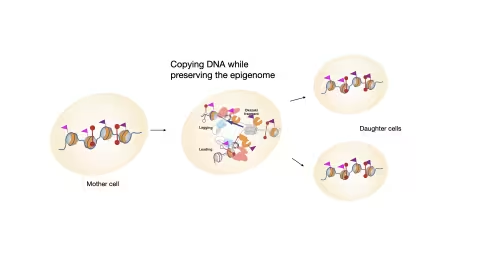
Our team is exploring the mechanisms of chromosome replication, taking into account both genomic DNA and chromatin, which carries essential and complex epigenetic information. Our research combines the development of cutting-edge genomic methods with the study of chromatin biology to understand the links between genome replication, epigenome maintenance, and their impact on genome stability and evolution.
We seek to understand how our cells coordinate the copying of their DNA with the preservation of their epigenome—the additional layer of information that controls gene activity and defines the identity and function of each cell type. Although all cells have virtually the same DNA, it is organized differently by chromatin, a structure composed of DNA, proteins, and various marks.
During cell division, the DNA and these chromatin marks must be faithfully replicated. However, DNA replication disrupts chromatin, threatening the stability of genetic and epigenetic information. The two DNA strands are copied using very different mechanisms: one strand is synthesized continuously, while the other is assembled discontinuously, in the form of short fragments known as Okazaki fragments. Consequently, the mechanisms for maintaining epigenetic information differ between the two strands, and the discontinuous strand is particularly vulnerable to errors and the insertion of mobile genetic elements.
Recent work by the laboratory has demonstrated that the maintenance of DNA methylation, the key epigenetic pathway for the transcriptional silencing of transposable elements, is functionally coupled to the synthesis of the discontinuous strand via the UHRF1-LIG1-PCNA-PAF15 pathway. This epigenetic mechanism targets transposable elements during discontinuous-strand replication, but paradoxically, this same strand is their preferred insertion site—particularly for L1, SINE, and satellites—because the interference between methylation and replication disrupts the maturation of Okazaki fragments and prolongs the presence of PCNA at the replication fork, creating a window conducive to their insertion. These results reveal a two-way dynamic: retrotransposons exploit the asymmetry of the replication fork to insert themselves, while the host genome counters this with epigenetic silencing coupled to replication. More broadly, the laboratory’s work demonstrates that the continuous and discontinuous strands are distinct, with implications for mutation rates, DNA repair, and genome stability.
Team members
-
PETRYK Nataliya - Team Leader
Research Associate and Equivalents, CNRS
Marion COULEE
Postdoctoral Researcher, CNRS
DUPUY Corinne
Research Director and Equivalents, CNRS
Nora FAJRI
Research Engineer or equivalent, CNRS
PIGEON Antoine
Ph.D. Student, Paris-Saclay University
Mira Saleh
Ph.D. student, Paris-Saclay University
Key publications
Other scientific productions
Contacts