Welcome to the new Gustave Roussy website
A new website designed to offer you a simpler, clearer, and more intuitive experience. Patients, caregivers, healthcare professionals, and donors: find information, news, and services more easily.
Genotoxic stress, monitoring of genome integrity, and cancer
- Thematic(s)
- Cell Dynamics, Genetics / Genomics
- Attachment unit
- UMR9019 - Genome Integrity and Cancer
- Manager(s)
- Olivier Gavet
- Institutional connection
-
Gustave Roussy, CNRS, Paris-Saclay University
Summary
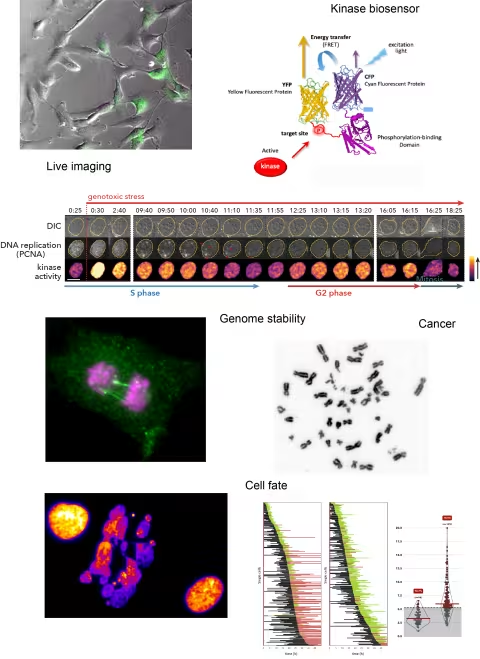
Maintaining the integrity of the genome is essential for preserving the functions and viability of the body’s cells. The team is studying DNA damage checkpoint mechanisms, which coordinate DNA repair and prevent the transmission of genetic alterations during cell division. Our research aims to elucidate how certain DNA lesions evade these control mechanisms and are transmitted to offspring during the early stages of tumorigenesis, thereby contributing to genetic instability and the development of cancers.
Our current research focuses on the ATR/CHK1 and ATM/CHK2 signaling pathways, which are activated in response to single- and double-strand DNA breaks, respectively—both of which are particularly harmful. We are studying the intrinsic functional limitations of these mechanisms, which are essential for genome stability. In the presence of persistent or irreparable damage, these control mechanisms can be bypassed (“checkpoint adaptation”), contributing to the onset of genetic instability and promoting resistance to various therapeutic treatments. Our research aims to characterize the molecular mechanisms involved as well as the genetic contexts that promote these events.
Ovarian cancers frequently exhibit alterations that affect DNA replication and induce chronic activation of the ATR/Chk1 signaling pathway, as well as deficiencies in double-strand break repair associated with the ATM/Chk2 pathway. We analyze the activation signatures of these surveillance mechanisms across different genetic contexts to understand how tumor cells maintain their proliferation and under what conditions inhibiting these mechanisms could provide a therapeutic advantage.
The team has recognized expertise in quantitative live-cell imaging and is developing innovative biosensors that enable real-time analysis of the activity and regulation of specific kinases at the single-cell level.
Our work contributes to a better understanding of the mechanisms responsible for genetic instability, tumor progression, and treatment resistance, with the goal of improving the prediction of treatment responses and the development of personalized therapies.
Team members
-
Olivier GAVET - Team Leader
MCF - Associate Professor, Paris Sorbonne
Louise Galey
Ph.D. Candidate, Paris-Saclay University
Morwenna Le Guillou
IE - Research Engineer or equivalent, Paris-Saclay University
MARTINEZ Lola
PhD Candidate, Paris-Saclay University
SCHINTU Niccolo
AI - Assistant Engineer or equivalent, CNRS
Key publications
Contacts
- Phone
- 01.42.11.56.83