Welcome to the new Gustave Roussy website
A new website designed to offer you a simpler, clearer, and more intuitive experience. Patients, caregivers, healthcare professionals, and donors: find information, news, and services more easily.
UNLOCK: understanding mechanisms of action and resistance to innovative treatments
Why do some patients respond to an innovative treatment while others develop resistance? The UNLOCK program aims to better understand how new cancer therapies work and why their effectiveness can vary from one patient to another.
The goal is to translate this knowledge into new therapeutic strategies and, ultimately, to better identify patients who are likely to benefit from a given treatment.
Why is it important to better understand innovative treatments?
Advances in research are enabling the development of new cancer therapies. However, some may prove insufficiently effective or cause excessive toxicity. One of the challenges is to understand precisely how these treatments act on a patient’s tumor and why some cancers respond while others develop resistance.
UNLOCK addresses this challenge by studying new therapies from the earliest stages of their evaluation in patients. The program combines clinical trial data with biological analyses to observe the effects of treatments on the tumor, its microenvironment, and disease progression.
What is the mission of the UNLOCK program?
To link observations made in patients during clinical trials with biological analyses performed on their samples, in order to better understand the mechanisms of action of and resistance to innovative treatments.
This knowledge should help identify new therapeutic strategies and improve patient selection as part of a precision medicine approach.
Clinical trials to study innovative therapies
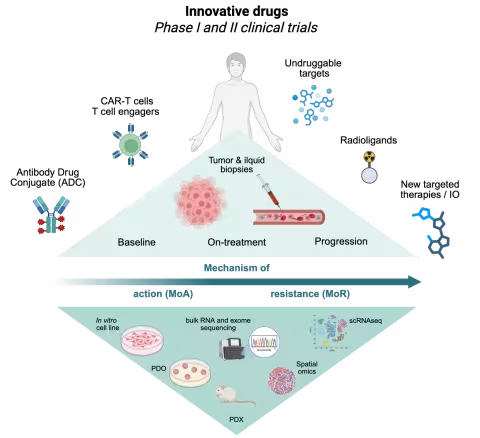
One of UNLOCK’s main ambitions is to open new early-phase clinical trials to investigate new drugs and offer patients new therapeutic opportunities. UNLOCK includes phase I clinical trials, corresponding to the earliest stages of evaluation in humans, as well as dedicated phase II trials designed to further assess these treatments.
The program explores five major categories of innovative therapies:
- new targeted therapies;
- therapies directed against targets previously considered undruggable;
- antibody-drug conjugates (ADCs);
- T-cell engagers and CAR-T cells;
- radioligands.
UNLOCK was originally designed for patients with metastatic cancer for whom standard treatments had proved ineffective. Since 2025, the program has also been studying new therapies administered before surgery, in what is known as the neoadjuvant setting.
Four objectives to better understand innovative treatments
UNLOCK is building a unique collection of tumor and liquid biopsies collected from the same patients before, during, and at the end of treatment. This longitudinal collection makes it possible to study changes in the tumor and its response to treatment over time. Samples collected during treatment are an essential resource for gaining new insights into tumor biology under treatment and understanding the mechanisms of action of new therapies.
The program develops and optimizes the use of new technologies to study treatments from multiple perspectives. The aim is to better understand their mechanisms of action, how they act on the tumor, as well as their mechanisms of resistance, which may explain why a treatment loses effectiveness or does not achieve the expected efficacy.
Knowledge gained from clinical trials and biological analyses should make it possible to identify new therapeutic strategies for patients with cancer.
UNLOCK aims to better characterize patients and their disease in order to improve patient stratification to identify different profiles that may respond differently to treatments. The objective is to offer each patient the most appropriate treatment protocol as part of a precision medicine approach.
What outcomes are expected?
UNLOCK has a dual objective: to give patients access to innovative therapies and to better understand how these treatments affect the tumor and disease progression.
Ultimately, the knowledge gained through UNLOCK should help better identify patients who are likely to benefit from a given therapy and support the emergence of new therapeutic strategies.
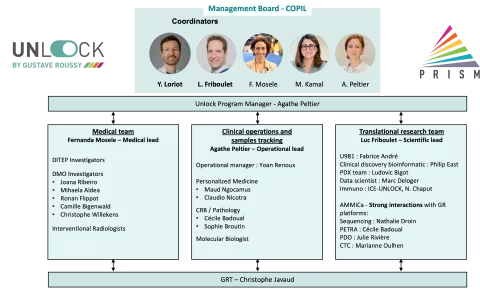
The UNLOCK program executive team
Pr Yohann Loriot
Program Coordinator
Drug Development Department (DITEP), Gustave Roussy; PRISM Institute; INSERM U981
Dr Luc Friboulet
Co-Coordinator and Scientific Lead
INSERM U981; PRISM Institute
Dr Fernanda Mosele
Medical Lead
Drug Development Department (DITEP), Gustave Roussy; PRISM Institute; INSERM U981
Dr Maud Kamal
Executive Director of the PRISM Institute
Dr Agathe Peltier
Program Scientific manager
The UNLOCK program is coordinated at Gustave Roussy and brings together medical, scientific, and program coordination expertise.