
Welcome to the new Gustave Roussy website
A new website designed to offer you a simpler, clearer, and more intuitive experience. Patients, caregivers, healthcare professionals, and donors: find information, news, and services more easily.
TLS Polymerases and Cancer
Group leader
Patricia Kannouche
Pavillon de recherche 2, Level 3
Current research
Group TLS Polymerases: Genome Plasticity and Cancers
This group belongs to the team "TLS Polymerases: Genome Plasticity and Cancers"
All cells are continuously exposed to a multitude of DNA damaging insults, which, if left unrepaired, can be life-threatening for organisms. DNA damage is particularly toxic when encountered during DNA replication, as replicative DNA polymerases are unable to replicate past DNA lesions and this can result in the stalling of replication forks, and potentially giving rise to chromosomal rearrangements if the fork collapses. To alleviate this threat, cells have evolved DNA damage tolerance strategies such as translesion DNA synthesis (TLS), which involves low fidelity DNA polymerases that can replicate damaged DNA, albeit in an error-prone manner, offering a trade-off between limited mutagenesis and chromosomal rearrangements. How DNA damage bypass pathways are regulated and coordinated with DNA replication is not completely understood.
The past 15 years have seen a dramatic advance in our understanding of how this tolerance pathway acts in response to exogenous DNA damage and how this can lead to mutagenesis. One crucial clue of the regulation of TLS relies on post-translational modifications of key effectors in the TLS reaction such as the well-documented mono-ubiquitination of PCNA by the Rad6/Rad18 complex. We and other have shown, that in human cells UVs provoke the mono-ubiquitination of PCNA at Lys164 which facilitates the translesion synthesis by recruiting TLS polymerases at stalled replication forks, providing an attractive mechanism for the “polymerase switch” at DNA lesion.
The purpose of our research is
- to deciphering the regulation of these TLS polymerases (named Pol eta, kappa, iota, zeta, Rev1...) in mammalian cells, especially Pol eta which is deficient in cancer-prone xeroderma pigmentosum variant (XPV) syndrome.
- to define more precisely the mechanistic details of TLS process and the consequences on mutagenesis and genetic instability in higher eukaryotes.
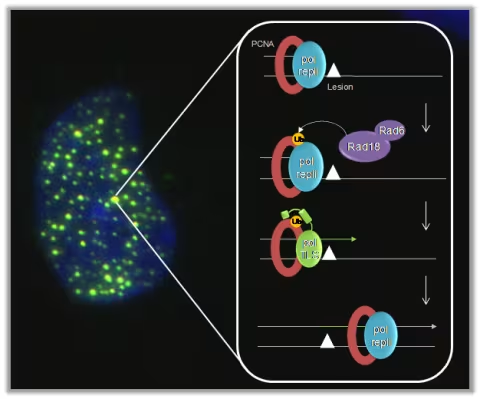
Légende : (left) Intranuclear localisation of the TLS polymerase eta detected by immunofluorescence, (right) schematic representation of TLS process
Recently, we have also initiated a new line of research that aims to understand how epigenetic information is maintained during replication stress and the coordination of this process with DNA replication and the mechanisms of DNA Damage Tolerance.
Our specific approach is based on tools that combine molecular biology, cellular biology and genetics as well as genome-wide approaches such as Chip-seq and WGS. We have also developed in our lab DNA combing and iPOND techniques to decipher DNA replication dynamic in mammalian cells.
Publications
Publications since 2008
- Sana Ahmed-Seghir, Caroline Pouvelle, Emmanuelle Despras, Agnès Cordonnier, Alain Sarasin and Patricia L Kannouche. Aberrant C-terminal Domain of Polymerase eta Targets the Functional Enzyme to the Proteosomal Degradation Pathway. DNA Repair, in revision.
- Guervilly JH, Takedachi A, Naim V, Scaglione S, Chawhan C, Lovera Y, Despras E, Kuraoka I, Kannouche P, Rosselli F, Gaillard PH. The SLX4 Complex Is a SUMO E3 Ligase that Impacts on Replication Stress Outcome and Genome Stability. Mol Cell. 2015 Jan 8;57(1):123-37. doi: 10.1016/j.molcel.2014.11.014. Epub 2014 Dec 18.
- Opletalova K, Bourillon A, Yang W, Pouvelle C, Armier J, Despras E, Martin L, Mateus C, Robert C, Kannouche P, Soufir N, Sarasin A. Correlation of Phenotype/Genotype in a Cohort of 23 Xeroderma Pigmentosum-Variant Patients Reveals 12 New Disease-Causing POLH Mutations. Hum Mutat. 2013 Oct 15. doi:10.1002/humu.22462.
- Bacquin A, Pouvelle C, Siaud N, Perderiset M, Salomé-Desnoulez S, Tellier-Lebegue C, Lopez B, Charbonnier JB, Kannouche PL. The helicase FBH1 is tightly regulated by PCNA via CRL4(Cdt2)-mediated proteolysis in human cells. Nucleic Acids Res. 2013 May 15. [Epub ahead of print].
- Shoaib M, Kulyyassov A, Robin C, Winczura K, Tarlykov P, Despas E, Kannouche P, Ramanculov E, Lipinski M, Ogryzko V. PUB-NChIP--"in vivo biotinylation" approach to study chromatin in proximity to a protein of interest. Genome Res. 2013 Feb;23(2):331-40. doi: 10.1101/gr.134874.111. Epub 2012 Oct 4.
- Despras E, Delrieu N, Garandeau C, Ahmed-Seghir S, Kannouche PL. Regulation of the specialized DNA polymerase eta: revisiting the biological relevance of its PCNA- and ubiquitin-binding motifs. Environ Mol Mutagen. 2012 Dec;53(9):752-65. doi: 10.1002/em.21741. Epub 2012 Oct 18.
- Zlatanou A, Despras E, Braz-Petta T, Boubakour-Azzouz I, Pouvelle C, Stewart GS, Nakajima S, Yasui A, Ishchenko AA, Kannouche PL. The hMsh2-hMsh6 complex acts in concert with monoubiquitinated PCNA and Pol η in response to oxidative DNA damage in human cells. Mol Cell. 2011 Aug 19;43(4):649-62. doi: 10.1016/j.molcel.2011.06.023.
- Kulyyassov A, Shoaib M, Pichugin A, Kannouche P, Ramanculov E, Lipinski M,Ogryzko V. PUB-MS: a mass spectrometry-based method to monitor protein-protein proximity in vivo. J Proteome Res. 2011 Oct 7;10(10):4416-27. doi: 10.1021/pr200189p. Epub 2011 Sep 2.
- Tissier A, Janel-Bintz R, Coulon S, Klaile E, Kannouche P, Fuchs RP, Cordonnier AM. Crosstalk between replicative and translesional DNA polymerases: PDIP38 interacts directly with Poleta. DNA Repair (Amst). 2010 Aug 5;9(8):922-8. doi: 10.1016/j.dnarep.2010.04.010.
- Despras E, Daboussi F, Hyrien O, Marheineke K, Kannouche PL. ATR/Chk1 pathway is essential for resumption of DNA synthesis and cell survival in UV-irradiated XP variant cells. Hum Mol Genet. 2010 May 1;19(9):1690-701. doi: 10.1093/hmg/ddq046. Epub 2010 Feb 1.
- Petta TB, Nakajima S, Zlatanou A, Despras E, Couve-Privat S, Ishchenko A, Sarasin A, Yasui A, Kannouche P. Human DNA polymerase iota protects cells against oxidative stress. EMBO J. 2008 Nov 5;27(21):2883-95. doi: 10.1038/emboj.2008.210. Epub 2008 Oct 16.
- Niimi A, Brown S, Sabbioneda S, Kannouche PL, Scott A, Yasui A, Green CM, Lehmann AR. Regulation of proliferating cell nuclear antigen ubiquitination in mammalian cells. Proc Natl Acad Sci U S A. 2008 Oct 21;105(42):16125-30. doi: 10.1073/pnas.0802727105. Epub 2008 Oct 9.
- Daboussi F, Courbet S, Benhamou S, Kannouche P, Zdzienicka MZ, Debatisse M, Lopez BS. A homologous recombination defect affects replication-fork progression in mammalian cells. J Cell Sci. 2008 Jan 15;121(Pt 2):162-6. Epub 2007 Dec 18.
Lab members
Lab members
- Patricia Kannouche (Directeur de recherche- CNRS), Manager
- Caroline Pouvelle (TCN CNRS)
- Emmanuelle Despras (Post-Doc GR)
- Sana Ahmed-Seguir (PhD student)
- Noémie Delrieu (PhD student, 4ème année ED Cancérologie, University Paris Sud)
- Yann Benureau (Engineer d’étude, GR- SIRIC)
- Mégane Bouvet (Technician, CDD-CNRS)
- Barbara Ben Yamin (Engineer assitant, CDD-CNRS)