
Welcome to the new Gustave Roussy website
A new website designed to offer you a simpler, clearer, and more intuitive experience. Patients, caregivers, healthcare professionals, and donors: find information, news, and services more easily.

Ensuring That Advances in Cancer Research Benefit Everyone
The apprenticeship tax, which is payable by businesses, is intended to help fund the expenses necessary for the development of technological and vocational training programs.
Gustave Roussy Education is authorized to collect the 13% portion of the apprenticeship tax (also known as the “balance” or “non-quota” portion) through the Paris-Saclay University School of Medicine.

How do you pay your apprenticeship tax to Gustave Roussy Education?
- 1/ Go to soltea.education.gouv.fr
- 2/ Search by UAI Code: 0940918M
- 3/ Select UFR Medicine, University of Paris-Saclay
- 4/ Select “DOCTORATE IN ONCOLOGY”
Selecting the oncology category ensures that funds are directed to Gustave Roussy Education to support its educational projects.
Your tax directly funds educational projects
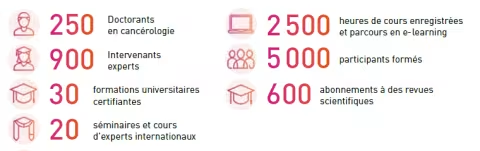
- Support for the design and implementation of more than 3,000 hours of coursework
- Development of digital resources and e-learning courses
- Acquisition of journals, books, and databases by the medical library
80% of patients cured by 2040
To achieve this historic goal, Gustave Roussy is innovating at every stage of cancer treatment.
The Power of Training
At Gustave Roussy, innovation doesn’t stop at the laboratories or technical facilities—it also spreads through training. Training doctors, paramedical professionals, and healthcare staff interested in oncology is essential to ensuring that these advances benefit everyone, everywhere.
For example, major advances in personalized screening and prevention, as well as in the individualization of care pathways, are profoundly transforming the way patients are diagnosed and supported. To accelerate the dissemination of this knowledge and these practices, Gustave Roussy Education is launching a new University Diploma in 2026 dedicated to personalized prevention, designed for healthcare professionals so they can identify, at an early stage, individuals at increased risk of developing cancer.
Backed by a thematic conference in partnership with The Lancet and led by an expert from Harvard University, this program will facilitate the sharing of innovative, interdisciplinary, and practical approaches drawn directly from real-world experience.
Payment
Commitment to Pay the Apprenticeship Tax
You can enter your company’s information in this form.
This is a payment commitment. However, you must complete the allocation process on the website www.soltea.education.gouv.fr
Your payment commitment will allow us to track your allocation to Gustave Rousssy Education.
To find out the amount of your apprenticeship tax, log in to your net-entreprises.fr account and review your April DSN (Nominative Social Declaration).
Apprenticeship Tax Form
Affected companies
Eligibility for the Apprenticeship Tax: Affected Companies
Learn about the rules governing liability for the apprenticeship tax and the Supplementary Apprenticeship Contribution (CSA), and determine whether your company is required to pay them.
The reform of the apprenticeship tax, which began several years ago with Law No. 2018-771 of September 5, 2018, on the freedom to choose one’s professional future, is nearing completion with one final aspect, to be implemented in 2023: collection by URSSAF via the DSN, rather than by OPCOs (skills operators) or OCTAs (apprenticeship tax collection agencies) as in the past (see Law No. 2021-1900 of December 30, 2021). While the main portion of 87% of the apprenticeship tax is still to be paid to URSSAF, it is now the remaining 13% that is also collected by URSSAF starting with the 2023 apprenticeship tax based on 2022 compensation.
Which companies are subject to the apprenticeship tax?
All companies located in France that are subject to income tax or corporate tax and employ at least one employee are subject to the apprenticeship tax.
These employers are therefore required to contribute, in proportion to their total payroll, to the development of apprenticeships in France and to the funding of initial vocational and technical training.
The companies in question may be of various types:
- corporations
- sole proprietorships
- commercial enterprises
- craft businesses
- agricultural cooperatives
- economic interest groups (EIGs)
Who is exempt from the apprenticeship tax?
However, certain businesses that meet the eligibility criteria may be exempt from the apprenticeship tax. This exemption applies to:
- businesses that employ at least one apprentice and whose total payroll is less than or equal to six times the annual minimum wage (SMIC)
- certain non-commercial civil partnerships (SCM)
- employer groups consisting exclusively of farmers or exempt agricultural civil partnerships
- legal entities whose sole purpose is education
Who must pay the Additional Apprenticeship Contribution (CSA)?
Certain companies must pay the supplementary apprenticeship contribution (CSA) in addition to the apprenticeship tax. The CSA is payable by companies with at least 250 employees that have fewer than 5% of their average annual workforce consisting of work-study students under apprenticeship contracts, professional training contracts, or CIFRE agreements (industrial training through research agreements).
This contribution is intended to encourage the hiring of apprentices in large companies.
However, certain companies may be exempt from the CSA if they have at least 3% of their workforce consisting of apprentices or employees in the positions mentioned above and:
- have seen their number of work-study students increase by 10% compared to the previous year
Two changes are worth noting for 2023:
- international corporate volunteer positions (VIE) and temporary workers will be excluded from the calculation of the work-study student ratio;
- the CSA exemption linked to a commitment by the professional sector to increase the number of work-study students has been eliminated.
How much are the apprenticeship tax and the supplementary apprenticeship contribution (CSA)?
Payable by French companies, the apprenticeship tax and the supplementary apprenticeship contribution are based on the company’s total payroll.
Calculation
Is your company required to pay the one-time contribution for vocational training and work-study programs? Find out how to calculate the amount of the apprenticeship tax and help support the development of vocational training in France.
Owed by companies subject to corporate income tax or income tax to fund training in technology and vocational fields, the apprenticeship tax was recently merged with the vocational training contribution and now constitutes the single contribution for vocational training and work-study programs. Employers liable for the tax are free to choose the training organization to which they will pay the balance of their apprenticeship tax.
How much are the apprenticeship tax and the Supplementary Apprenticeship Contribution (CSA)?
Amount of the apprenticeship tax
The apprenticeship tax is calculated based on the previous year’s payroll, which is the total of wages paid to employees and subject to social security contributions, plus benefits in kind provided by the company.
When calculating the total payroll for apprenticeship tax purposes, apprentices’ wages are fully exempt for employers with 10 or fewer employees and exempt up to 11% of the minimum wage for employers with 11 or more employees.
The apprenticeship tax is 0.68% of the previous year’s payroll (0.44% in Alsace-Moselle). The resulting amount is divided into two parts:
- a main portion of 0.59% intended to fund apprenticeships, collected by Urssaf or the MSA
- a balance of 0.09% intended to fund initial, technical, and vocational training, collected by Urssaf or the MSA (referred to as the “balance,” excluding quotas or expenses that fulfill the obligation).
Visit the page dedicated to the apprenticeship tax or find out why you should pay your apprenticeship tax to Gustave Roussy Education.
Amount of the Supplementary Apprenticeship Contribution (CSA)
Companies subject to the CSA must pay an additional amount, calculated on the same basis as the apprenticeship tax. The CSA is due annually on April 5 or 15 of year N, based on the total payroll for year N-1.
Its rate decreases in proportion to the percentage of work-study students employed relative to the average annual workforce:
|
Percentage of work-study students |
CSA Rate |
|---|---|
| Less than 1% | 0.4% (0.6% if the company has 2,000 or more employees) |
| Between 1% and less than 2% | 0.2% |
| Between 2% and less than 3% | 0.1% |
| Between 3% and less than 5% | 0.05% |
| > 5% | Exempt |
Companies located in the departments of Alsace-Moselle benefit from reduced rates for the supplementary apprenticeship contribution.
In Alsace-Moselle
|
Percentage of work-study students |
CSA rate in Alsace-Moselle |
|---|---|
| Less than 1% | 0.208% (0.312% if the company has 2,000 or more employees) |
| Between 1% and less than 2% | 0.104% |
| Between 2% and less than 3% | 0.052% |
| Between 3% and less than 5% | 0.026% |
| > 5% | Exempt |
What expenses are deductible from the apprenticeship tax?
The following expenses may be deducted from the main portion of the apprenticeship tax:
- Expenses for investments intended to finance the equipment and materials necessary to provide training for one or more of the company’s apprentices at the company’s own apprentice training center (CFA).
- Payments toward investments intended to finance the equipment and materials necessary for the apprentice training center (CFA) to establish a new apprenticeship training program, when such a program is used to train one or more of the company’s apprentices.
- The following expenses may be deducted from the balance of the apprenticeship tax:
- subsidies paid to an apprentice training center (CFA) in the form of equipment and materials that meet the needs of the training programs offered (Article L.6241-4 of the Labor Code).
- The work-study credit available to companies with 250 or more employees that exceed the 5% threshold for work-study students.