Welcome to the new Gustave Roussy website
A new website designed to offer you a simpler, clearer, and more intuitive experience. Patients, caregivers, healthcare professionals, and donors: find information, news, and services more easily.
Stories from Those Affected – Olivier, in remission from colorectal cancer
“It was at the Institute that I was told my tumor was linked to a genetic mutation, because I have Lynch syndrome.”
Published on
Changed on
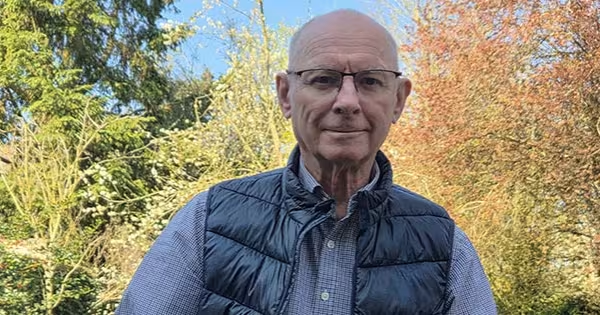
To mark Blue March, a month dedicated to raising awareness about colorectal cancer and screening, Olivier, 80, who is being treated for this disease at Gustave Roussy, reflects on his treatment journey and his personal and shared experience as a couple in dealing with the disease.
“After studying at business school, I spent the final years of my professional career managing various healthcare facilities. At the same time, my wife and I have been committed to helping couples in distress since the beginning of our marriage. We started out as marriage counselors and then deepened our knowledge by earning a university degree in sexology. Even today, I still meet with patients. It’s one thing to work in the medical field, but it’s quite another to be on the patients’ side.
My symptoms began with stomach pain in April 2022. My primary care physician initially thought it was nothing serious, but the pain persisted. It wasn’t until late 2022 that I was scheduled for a colonoscopy. Following that exam, I was told I had colon cancer. My wife immediately insisted that I be treated at Gustave Roussy. We got an appointment very quickly, and it was at the Institute that I was told my tumor was linked to a genetic mutation, as I carry the Lynch syndrome.
I was made to feel very welcome, both by the doctors and the medical assistants. So much so that I actually looked forward to going to my appointments. My wife always accompanied me, because we wanted to face this challenge together, placing our complete trust in the medical team throughout my treatment journey. I started with a few months of treatment, then underwent surgery and went through cycles of chemotherapy. The surgery was performed with the help of a robot and went very smoothly—I was discharged just a few days later. As for the chemotherapy, I received my treatment as an outpatient, which allowed me to go home at the end of each session. This arrangement allowed me to continue my daily activities.
I was lucky to have a “mild” form of cancer, with an MSI mutation, which responds particularly well to immunotherapy. I underwent treatment throughout 2023. I experienced some side effects, and to this day I still have sensitivity in my feet and fingers, known as neuropathy. It’s a bit of a nuisance in my daily life, since I really enjoy doing DIY projects.
The most difficult part of this entire experience was when we had to tell our five children that they were at risk of developing colorectal cancer, since I carry a genetic predisposition to colon cancer. Two of them have already taken the test, and one of them tested positive. It’s a reality we have to learn to live with, together.
Today, life goes on as before; I wake up every morning thinking about what I’m going to do with my day. It’s very important to stay busy and hold on to the meaning we want to give to our lives. Even during my treatments, I was able to continue my activities. A little slower, sure, but still active. I now make sure to walk 5,000 steps a day.
The most important advice I could give is to trust your doctors and caregivers. Today, my test results are good, and at every follow-up appointment at Gustave Roussy, I’m told that everything is fine. I personally consider myself a “happy cancer patient”—a term I sometimes shorten to “cancereux.”
Last news
-
Breast Cancer: Gustave Roussy Ranked No. 1 in France for Breast Surgery and Breast Reconstruction
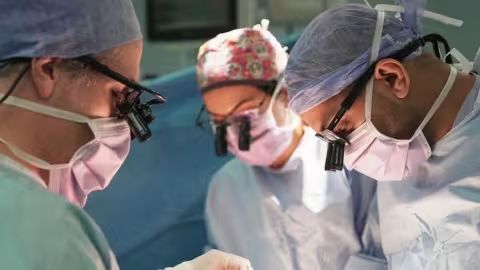
On the occasion of Breast Cancer Awareness Month, the 2025 data from Visuchir, the national surgical activity monitoring tool of the French Health Insurance system, places Gustave Roussy in first position for both breast surgery and breast reconstruction. Beyond this ranking, these figures highlight that reconstruction is now an integral part of breast cancer treatment. It is considered at every stage of care: from tumor removal surgery, whether lumpectomy or mastectomy, through to the post-cancer period, helping to restore the body and support women in regaining their physical integrity and quality of life.
-
Newsweek Ranking: Gustave Roussy Named Europe’s Leading Cancer Centre and Third Best Worldwide
The 2027 edition of Newsweek’s World's Best Specialized Hospitals ranking once again recognises Gustave Roussy as the leading cancer centre in France and Europe, and the third best worldwide. This distinction highlights the excellence of the Institute’s care and research, as well as the daily commitment of all its professionals.

-
Living with and beyond cancer: the promises and challenges of digital health
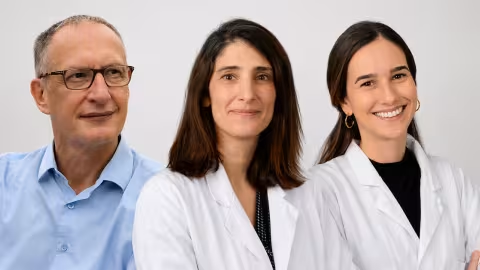
In a Viewpoint article published in The Lancet Digital Health, Drs Ines Vaz-Luis and Maria Alice Franzoi, together with Emmanuel Mussault, a patient partner at the PRISM University Hospital Institute, examine the role that digital tools can play in supporting people living with and beyond cancer. Their central message is that these technologies can support more personalised and accessible care, but their value depends primarily on how they are integrated into care pathways, the human support provided, their ability to address individual needs and their evaluation in real-world settings.
-
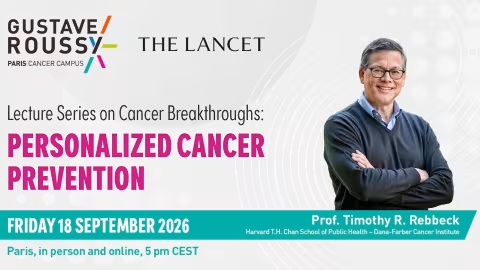
Gustave Roussy and The Lancet launch an international lecture series on innovations transforming cancer care
The inaugural lecture in the “Lecture Series on Cancer Breakthroughs” will take place on Friday 18 September at 5:00 pm. It will be delivered by Professor Timothy R. Rebbeck, a leading cancer prevention specialist at Harvard University and the Dana-Farber Cancer Institute.