
Welcome to the new Gustave Roussy website
A new website designed to offer you a simpler, clearer, and more intuitive experience. Patients, caregivers, healthcare professionals, and donors: find information, news, and services more easily.
Immunotherapy: Cell-Based Therapies
Cell therapies are innovative therapeutic drugs that use the patient’s own cells, which may or may not be genetically modified in the laboratory to acquire new functional properties before being re-injected into the patient. When applied to cancer treatment, they aim to train immune system cells so that they can more effectively attack the patient’s cancer cells.
Until now, researchers have focused their work on certain types of white blood cells—T lymphocytes—known for their role in the antitumor immune response and their ability to destroy diseased cells, such as tumor cells. In 2019, Gustave Roussy received authorization to treat patients with this new therapeutic approach using CAR-T cells.
At Gustave Roussy, several studies are underway in the field of cell therapies. “Innovative cell therapy in oncology currently aims to genetically reprogram certain cells of the patient’s immune system to use them as a treatment,” explains Prof. Nathalie Chaput, director of the Immuno-Monitoring Laboratory in Oncology at Gustave Roussy.
Principle
Modifying immune cells from a healthy donor or a
patient to give them the ability to easily
recognize tumor cells or to force them to attack tumor cells
.
Example
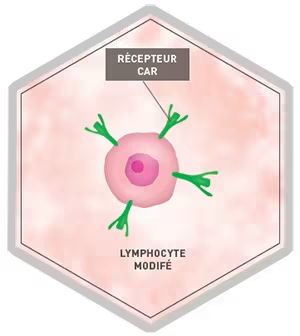
CAR-T cells: The patient’s T cells are harvested, then modified
before being reinfused into the patient’s bloodstream. A CAR receptor, specific to the patient’s type of cancer, is
added to their surface.
Cell Therapies for Fighting Cancer
CAR-T cells
CAR-T cells are T lymphocytes that have been genetically modified to express a receptor called CAR (Chimeric Antigen Receptor), which gives them the ability to specifically target cancer cells, activate upon recognizing them, and destroy them.
T cells are key cells of the immune system, responsible for the immune response aimed at destroying pathogens or abnormal cells such as cancer cells. However, various immune evasion mechanisms developed by cancer cells allow them to inactivate T cells—a dynamic that CAR-T cell therapy aims to counteract.
To do this, T cells are collected from the patient via apheresis (a technique for separating blood cells) and genetically modified in the laboratory to express a specific CAR receptor on their surface. After being multiplied in the laboratory and reinfused into the body, these T cells become capable of recognizing and destroying tumor cells that express the CAR’s target.
The efficacy of cell therapies using CAR-T cells has so far been demonstrated only for certain hematologic cancers. Results obtained in treating solid tumors remain disappointing, due to the difficulty CAR-T cells have in leaving the bloodstream.
Since 2019, CAR-T cells have been used at Gustave Roussy to treat children and young adults with acute lymphoblastic leukemia, as well as adults with diffuse large B-cell lymphoma, with encouraging results. Forty percent of patients in the latter group achieved a complete response following a single infusion of CAR-T cells, with no disease relapse after two years.
Tumor-infiltrating lymphocytes (TILs)
Tumor-infiltrating lymphocyte (TIL) therapies are cell-transfer therapies designed to mobilize cancer patients’ own lymphocytes and immune responses to fight the disease.
Infiltrating Lymphocytes
TILs comprise three types of cells—B lymphocytes, T lymphocytes, and natural killer (NK) cells—all of which have infiltrated the tumor and its stroma, or the surrounding tumor microenvironment. These infiltrating lymphocytes are harvested directly from the patient’s tumor, then expanded in the laboratory, before being reinfused into the patient to fight the disease.
This form of cell therapy, which does not require genetic modification of the lymphocytes—unlike CAR-T cells—is now considered one of the most promising cancer treatments, particularly effective against certain solid tumors.
In practice, TIL therapy consists of six main steps: 1:
- A 1–2 cm tumor lesion is surgically resected from the patient to harvest infiltrating lymphocyte units.
- This lesion is then placed in a culture medium rich in interleukin-2, a cytokine identified as a growth factor for T lymphocytes. The TILs are separated from the tumor cells and stroma and grow exponentially; this growth is then enhanced by an automated cell culture system.
- To best prepare the body to receive the TILs, the patient undergoes lymphocyte-depleting chemotherapy for 5 to 7 days beforehand. This creates an environment conducive to the injection of the expanded lymphocytes.
- Once chemotherapy is complete, the patient receives the expanded TILs via infusion, under close medical supervision.
- Interleukin-2 (IL-2), which is already used in the laboratory, is then administered to the patient in high doses following the TIL transfusion.
- During the post-treatment phase, several guidelines must be followed. To prevent graft-versus-host disease, lifelong transfusions of irradiated blood products are necessary. Corticosteroids, on the other hand, must be completely avoided.
TILs at Gustave Roussy
The Institute is participating in the PragmaTIL program, a clinical trial funded in part by the European Union. Its goal is to optimize TIL therapies in order to expand their use in hospitals while reducing major toxicities.
Currently, high-dose interleukin-2 administered to the patient after TIL injection is necessary to maintain the development and activation of the cells once they are in the body. However, it is also responsible for numerous side effects, which require constant and increased monitoring of patients. The goal of PragmaTIL is to reduce this toxicity while maintaining the treatment’s efficacy.
Regarding clinical trials, Dr. Alexandra Leary is leading the Agenus C-700 clinical trial, which focuses on TILs in the treatment of cervical cancer. Professor Benjamin Besse is preparing to launch a clinical trial, CHIRON, using TILs to treat lung cancer.
Research
Modified immune cells. Scientific research to strengthen and advance cell therapy is expanding.
- Researcher Laurie Menger, team leader of the ATIP-avenir U1015 Gustave Roussy/Inserm team, is studying CAR-T cell exhaustion with the goal of counteracting it. To this end, several research projects are being conducted simultaneously. First, the team is studying CD4 T cells—which assist CD8 T cells in their fight against cancer cells—to better understand them. Research is being conducted on mitochondria, the intracellular powerhouses that T cells rely on to function. Finally, in collaboration with Prof. Florent Ginhoux and Prof. Véronique Minard-Colin, research is underway to develop a new type of CAR cell: CAR macrophages.
- Dr. Camille Bigenwald, a hematologist, is an investigator on the PIONEER study, which aims to understand the immune determinants of CAR-T cell response and toxicity. Her research seeks to identify biomarkers of efficacy in patients to determine in advance who will and will not respond to CAR-T cell therapy. Another objective is to understand the side effects, which can be severe, particularly neurological ones.
- Professor Véronique Minard-Colin is working on the clinical implementation of T cells genetically modified to express a new TCR (T-cell receptor capable of recognizing a tumor target). Unlike CAR-T cells, which recognize an antigen expressed on the tumor’s surface, this new receptor would target an intracellular antigen, opening up new possibilities for the treatment of certain solid tumors.
- Dr. Alexandra Leary is set to launch a clinical trial, titled SURPASS-3, which focuses on CAR-T therapy applied to solid tumors. This trial involves patients with ovarian cancer.
“Therapeutic Trojan horses.” A promising therapy developed at Gustave Roussy, modified autologous monocytes—or “therapeutic Trojan horses”—are being developed by researcher Jean-Luc Perfettini and his team within the “Cell Death, Immunity, and Therapeutic Innovation,” affiliated with UMR 1030 “Molecular Radiotherapy and Therapeutic Innovation.”
Specifically, this cell therapy involves harvesting monocytes—another type of white blood cell—from a patient and reprogramming them in the laboratory to overexpress the p21 protein. These monocytes are then re-injected into the body, where, after migrating into the tumor, they begin to phagocytose (or “eat”) cancer cells. The increased expression of the p21 protein allows the monocytes, once inside the tumor, to be reprogrammed into inflammatory macrophages that are “hyper-phagocytic” toward tumor cells.
By using monocytes as a vector to infiltrate the tumor, “therapeutic Trojan horse” technology harnesses a natural pathway of the immune system to attack cancer. Monocytes naturally migrate to sites of inflammation in the body, such as a tumor.
The arrival of modified autologous monocytes in a tumor will trigger an inflammatory reaction, facilitating the infiltration of T cells naturally present in the patient. Ultimately, the goal is to train the immune system so that this mechanism becomes sustainable over the long term, thereby preventing relapses.
Initial preclinical results have demonstrated the ability of modified autologous monocytes to reach tumor sites and kill cancer cells, leading to a reduction in tumor size and prolonged survival.
“Our advances with ‘therapeutic Trojan horses’ illustrate our collective ambition in this field, and other innovative biotherapies resulting from our research are currently under study,” emphasizes Jean-Luc Perfettini. “All of these developments in the field of cell therapies underscore Gustave Roussy’s commitment to moving from discovery to therapeutic trials in patients. A clinical research unit dedicated to innovative biotherapies, bringing together all stakeholders in the process, will enable us to treat patients on-site at Gustave Roussy,” concludes Prof. Nathalie Chaput.
1) Martins, F., et al. Principles of Adoptive Cell Therapy Using Tumor-Infiltrating Lymphocytes, Rev Med Suisse, Vol. 12, No. 519, 2016, pp. 989–993