Welcome to the new Gustave Roussy website
A new website designed to offer you a simpler, clearer, and more intuitive experience. Patients, caregivers, healthcare professionals, and donors: find information, news, and services more easily.
Curing Childhood Cancer in the 21st Century
Contact
Anne-Sophie de Boissard
Phone: +33 1 42 11 54 74
The campaign
The "Curing Childhood Cancer in the 21st Century" Campaign
In France, 1 in every 440 children will be diagnosed with cancer before the age of 15.
2,500 children and adolescents are diagnosed each year in France.
For 20% of them, there is currently no treatment available to cure them.
Their only hope lies in advances in research.
For our children and for future generations, here at Gustave Roussy, we have a bold ambition:

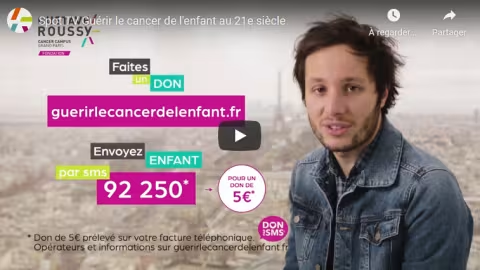
Under the leadership of Frédéric Lemos, chair of the “Curing Childhood Cancer in the 21st Century” campaign committee, his wife Magali, and all members of the committee, the Gustave Roussy Foundation decided in September 2017 to launch a fundraising campaign dedicated to pediatric oncology research.
By the end of 2019—in just two years—the first fundraising milestone of 10 million euros was reached, enabling the launch of major research projects in genetics, immunotherapy, and long-term follow-up, as well as the recruitment of a team of top-tier researchers.
The campaign, which has been represented since 2017 by Noé Lemos—who passed away from DIPG—is now entering a new phase to take it even further.
By mid-2023, the amount raised had exceeded our expectations and inspired us to think even bigger!
The €20 million raised will be allocated primarily to the campaign’s four priority areas, with plans to recruit new teams of researchers and experts and an investment plan to accelerate the pace of discoveries. These funds will also contribute to the future 30,000-square-meter research building—currently budgeted at 150 M€—which will house pediatric oncology research activities.
The tremendous generosity of numerous donors and institutional sponsors has already enabled the doctors and researchers at Gustave Roussy to generate new insights into the biology and immunology of pediatric cancers, from which patients will benefit directly through thethe identification of therapeutic targets that will enable the development of new, dedicated drugs. This campaign aims to have a rapid societal impact.
This new, crucial phase—“From Target to Drug”—will obviously require new investments.
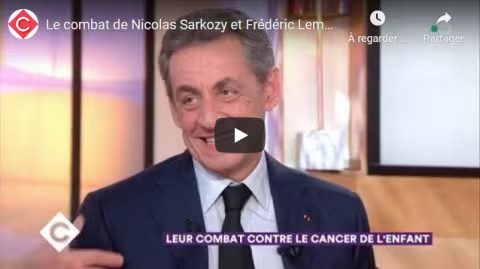
Sponsored by President Nicolas Sarkozy, the campaign “Curing Childhood Cancer in the 21st Century” draws on Noé’s story to fuel hope for curing future generations of children affected by cancer.
A pioneer in the care of young patients with the creation in 1950 of France’s first pediatric oncology department, Gustave Roussy remains committed to improving the survival rates and quality of life of these young patients, as well as the comprehensive care provided to the child and their family during and after treatment.
“Gustave Roussy has already demonstrated in the past, with both adults and children, its ability to change prognoses: thanks to the concentration of research resources and the number of patients treated at this unique facility. With our campaign, we are creating a new opportunity to bring together the world’s best researchers at Gustave Roussy and, very soon, enable certain children who were once considered beyond hope—like Noé—to lead normal lives.
Thank you for your support.”
Frédéric Lemos
, Chair of the Campaign
Committee, Chair of LFPI REIM

The Institute treats a wide range of pediatric cancers (neuroblastomas, brain tumors, bone and soft tissue tumors, lymphomas, germ cell tumors, rare tumors, etc.) and is particularly committed to ensuring that children with cancer have access to innovative treatments, notably through some thirty clinical trials.
Four Major Projects

IMMUNOTHERAPY
Developing effective immunotherapies for children and understanding how pediatric cancers evade the immune system.
Learn more

GENETICS
Understanding why some children develop cancer and identifying the genetic predispositions responsible for it.
Learn more

BETTER RECOVERY
Improving the quality of recovery for children and adolescents to understand, detect, and prevent long-term complications in adulthood.
Learn more

BRAIN TUMORS
Understanding the molecular mechanisms involved in the formation of these tumors and identifying potential therapeutic targets through the search for biological markers.
Learn more
A campaign committee made up of highly committed stakeholders
|

|
|
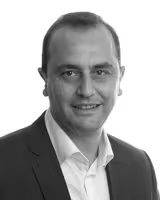
Frédéric LEMOS |
Nicolas SARKOZY |

|

|
| Anne-Sophie d’Andlau , Co-founder of CIAM |
Catherine Berjal , Co-founder of CIAM |
|

|
| Edouard CARLE , Co-President of BABILOU |
Sébastien VERDEAUX President of LETUS PRIVATE OFFICE |
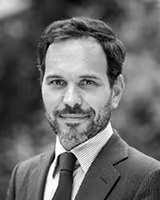
As Chair of the “Curing Childhood Cancer in the 21st Century” campaign committee, Frédéric Lemos is the driving force behind this ambitious project, which he dedicates to his son Noé, who passed away from cancer. Noé’s story fuels the hope of curing future generations of children affected by cancer.
Immunotherapy
Immunotherapy research is one of the four priority projects of the “Curing Childhood Cancer in the 21st Century” campaign.
Immunotherapy
The challenge is to understand how pediatric cancers evade the immune system in order to develop effective immunotherapies for children.
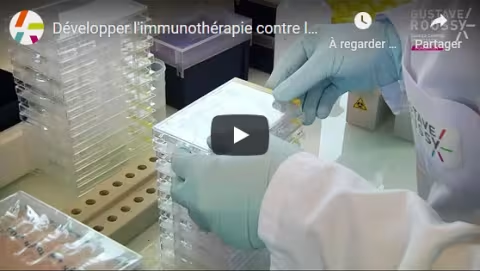
Gustave Roussy has assembled a world-class research team dedicated to the immunology of pediatric tumors and has equipped its new laboratories with the most innovative equipment, enabling, for example, the isolation and sequencing of individual cells (the “single-cell” approach).
Where do we stand in 2023?
❶ Using skin cells (fibroblasts), the teams have generated mini-organs (“organoids”) and immune cells to recreate the tumor microenvironment and test immunotherapies. To date, six brain organoids (mini-brains) are available for studying brain tumors. The ongoing “Immune Organoids” study aims to expand this approach to several other pediatric cancers.
These organoids will make it possible to:
- Identify and characterize the role of immune cells in tumor progression and the development of pediatric cancers,
- To identify new abnormalities specific to childhood cancers and target them (immunotherapy),
- Test new drugs in a suitable model that closely mimics the cancer that develops in children,
❷ An immune signature specific to malignant glial tumors was identified through artificial intelligence analysis of more than 10 “single-cell” immune databases.
❸ An analysis of a panel of genes involved in the immune system was conducted in over 500 children and adolescents with cancer. Initial results suggest that a cancer-induced genetic alteration of the immune system may exist.
❹ More than 50 tumors from newborns and infants were analyzed using a “single-cell” approach. Comparing tumor, blood, and healthy tissue samples identified several specific immune cell populations that play a role in the development of tumors in these very young children. In addition, a bioinformatics analysis of six international public “single-cell” databases of tumors and healthy tissues confirmed the importance of these immune cells in promoting tumor development. These cells could be targeted by certain immunotherapies.
❺ Two immunotherapies based on modified immune cells designed to eradicate tumor cells are in early-stage development in the laboratory (“preclinical” mouse models).
Realizing the Promise of Immunotherapy for Children
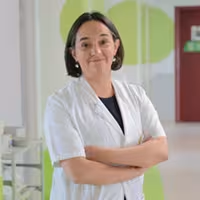
"Unlike adult cancers that are sensitive to immunotherapy, pediatric cancers have few T cells and therefore show little or no response to current immunotherapies. We must adapt and evaluate new, specific immunotherapy strategies for children."
Prof. Véronique MINARD COLIN, Pediatric Oncologist at Gustave Roussy
Watch the video for more details
Genetics
Genetics is one of the four major projects of the “Curing Childhood Cancer in the 21st Century” program.
Genetics
Today, a cause of cancer is identified in only 10% of children and adolescents treated for a tumor: they carry a pathogenic variant (or mutation) in a known cancer-predisposing gene.
To date, more than 60 syndromes associated with a predisposition to pediatric cancers have been identified. However, due to their rarity, many questions remain regarding the cancer risks associated with a large number of these predisposition syndromes.
- What is the risk of developing one (or more) tumors when a person carries the mutation?
- What other individual factors can influence this risk?
- What are the exact cancer risks (type of tumor and age of onset) for the patient and their relatives?
- What monitoring and screening program should be implemented?
Thanks to donations, the national PREDCAP registry—the Observatory of Genetic Predisposition Syndromes for Pediatric Cancer—has been established.
It is led by Gustave Roussy in partnership with the genetics laboratories responsible for assessing predispositions to childhood cancers throughout the country. Since obtaining the necessary regulatory approvals, it has been gradually rolled out across all SFCE (French Society for the Fight Against Cancers and Leukemias in Children and Adolescents) centers nationwide and aggregates data on children and adolescents with a known or suspected predisposition to cancer in France.
PREDCAP enables active, collaborative research in France with annual data updates and links between existing clinical and biological databases. It facilitates the creation of a sustainable national database linked to a multi-site biological sample bank.
Thus, this shared tool will help accumulate the knowledge needed to better assess individual and family cancer risk and to propose a potential screening program tailored to genes associated with pediatric cancer predisposition.
But what about other children for whom, due to their personal or family history, an as-yet-unidentified genetic predisposition is suspected?
GENECAP aims to answer this question by studying patients selected based on their personal or family history—patients for whom the possibility of a predisposition syndrome is being considered and in whom no abnormalities have been found in genes known to predispose to cancer. To date, 481 whole-genome sequencing analyses have been performed and are currently being analyzed to identify new predisposition genes not yet known.
How can we better understand oncogenesis in predisposition syndromes?
ORIGINE aims to model these diseases in vitro. Brain organoids have been developed from fibroblasts derived from skin biopsies of several children with a syndrome predisposing them to brain tumors, with the goal of studying how the tumor begins to develop. Two diseases are currently being studied: Li-Fraumeni syndrome, associated with a constitutional mutation in the p53 protein, and CMMRD syndrome, associated with a defect in the repair of point mutations in DNA. These experiments are time-consuming and involve a degree of uncertainty, but we hope to obtain initial results within the coming year. These organoids, which are unique in their creation, will enable us to validate the role of the new predisposition genes discovered through the GENECAP program.
Identifying Genetic Predispositions for Earlier Diagnosis
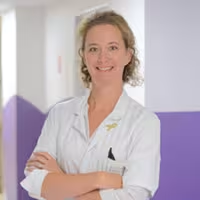
"The molecular techniques now available will enable us to identify predisposing abnormalities and develop new treatment strategies."
Dr. Léa Guerrini-Rousseau, pediatric oncologist at Gustave Roussy
Watch the video for more details
Heal Better
Improving quality of life after childhood cancer is one of the focuses of the “Curing Childhood Cancer in the 21st Century” fundraising campaign.
Better Care
Understanding, detecting, and preventing late complications from childhood and adolescent cancer treatments is a major priority for Gustave Roussy.
The long-term follow-up clinic in the Department of Pediatric and Adolescent Oncology, established in 2012, enables us to inform patients of their risks based on their medical history, as well as to screen for, manage, and prevent late complications.
Thanks to donations, the information gathered during these consultations has been compiled into a database covering the 1,000 patients who have attended long-term follow-up appointments since 2012.
This unique data set from a large cohort of patients who have recovered from pediatric cancer enables the development of specific studies.
For example, it has been shown that children who have been cured of neuroblastoma experience slowed growth during adolescence and have a final height below the average for adolescents of the same age. Early initiation of growth hormone supplementation is now recommended for these children and adolescents.
Patients who have recovered from an optic pathway glioma experience a decrease in visual acuity. The study funded by our campaign showed that 20% of cured patients also have endocrine disorders, obesity, and neurocognitive impairments that require specific early intervention.
Finally, the program revealed that only 30% of patients summoned attend the long-term follow-up appointments. The reasons for non-attendance—and thus for the lack of long-term follow-up for these pediatric cancer survivors at risk of late complications—are primarily socioeconomic.
During these follow-up visits, blood samples are collected to investigate whether there is a genetic predisposition to the development of these late complications. The research program is being carried out with the goal of sequencing the whole-genome DNA of the 1,000 patients who attended the follow-up visits.
Thanks to this initiative, a multidisciplinary research team focused on the long-term effects of treatments and the disease in survivors has been established. The results of studies already conducted are leading to changes in the care of these recovered patients. The program will continue to explore the cardiovascular complications of treatments and the as-yet-unknown complications of new drugs, such as immunotherapies and targeted therapies.
Identifying and detecting risks of complications early to improve recovery
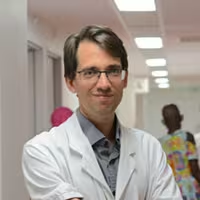
“New treatments (targeted therapies and immunotherapy) are being developed to cure children for whom standard treatments have failed. The long-term safety of these new drugs is not yet known.”
Dr. Brice Fresneau, Pediatric Oncologist at Gustave Roussy
Watch the video for more information
Brain Tumors
Research on childhood brain tumors is one of the four focus areas of the “Curing Childhood Cancer in the 21st Century” campaign.
Brain Tumors
Accelerating research and developing therapeutic innovations for a condition that has been considered incurable until now—diffuse intrinsic pontine glioma (DIPG)—is a challenge.
How can we achieve this?
Better Classification
Thanks to a precise molecular characterization linked to clinical data for each patient, we have identified a fifth type of diffuse midline glioma that progresses more slowly. These tumors consistently activate a signaling pathway that appears to slow progression. This discovery opens up new therapeutic possibilities.
Discovering New Vulnerabilities
Using synthetic lethality screens, in which gene expression is silenced without any preconceived notions, we have discovered two new therapeutic targets. These proteins are essential specifically for the survival of these tumors but not at all for normal cells. We have validated and studied the mechanism of action of the first one, called VRK3, and we will attempt to develop a new drug to block the action of this protein.
Better Treatment
The ongoing BIOMEDE 2.0 treatment protocol is evaluating a new drug, ONC201, right from the time of diagnosis, and it holds great promise. This is a European clinical trial led by Gustave Roussy that will offer this innovative treatment to more than 340 children with brainstem tumors. In this trial, all children undergo a comprehensive molecular analysis of their tumor at the time of diagnosis to tailor treatments as effectively as possible and to understand the mechanisms underlying tumor formation and treatment resistance. In addition, a tumor model is created for each patient whenever possible to test new drugs in vitro.
Thus, thanks to the financial support received, a Precision Medicine 2.0 and Therapeutic Innovation Acceleration program is underway for all children and adolescents (and even adults) with an infiltrating brainstem or midline tumor in France and Europe.
The final results of the BIOMEDE 1.0 protocol, which compared three drugs, were presented at the annual meeting of the American Society of Clinical Oncology in Chicago on June 4.
This international study (the largest ever conducted on this disease) demonstrated that it is possible to implement precision medicine based on the molecular profiling of a biopsy at diagnosis. It also helped establish a standard of care with everolimus, which is well tolerated and, when combined with radiation therapy, provides better disease control than radiation therapy alone.
DIPG is a rare disease with no established treatment and represents the greatest challenge in pediatric oncology.
“Infiltrating brainstem and midline gliomas are the most severe form of glioma in children and adolescents. In recent years, we have worked to gain a better biological understanding of these tumors, which has allowed us to refine their classification. Our focus now is on validating new treatments for patients using the research models we have established.”
Dr. Jacques Grill, pediatric oncologist at Gustave Roussy