
Villejuif, 4 February 2026
The 2026 Edition of the Gustave Roussy Prize Awarded to Prof. Luis Diaz Jr.
An international leader in colorectal cancers, immunotherapy, and liquid biopsy, Prof. Luis Diaz Jr. has been awarded the Gustave Roussy Award for his work leading to tangible advances for thousands of cancer patients worldwide. He demonstrated that certain tumours characterised by DNA instability (MSI) respond particularly well to immunotherapy. This discovery, and the widespread adoption of these treatments, has significantly improved survival for many patients with MSI-positive tumours. This fundamental observation helped make possible, for the first time in oncology, a cancer treatment based on the biological characteristics of the disease rather than the organ affected. His nomination, unanimously selected by the members of the Gustave Roussy Award jury, also highlighted his key role in the adoption of liquid biopsy in routine clinical practice.
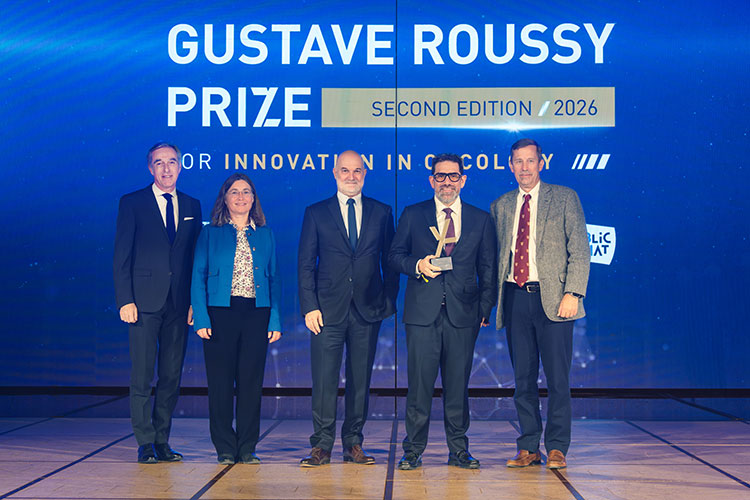
From left to right: Éric Ducournau, Chief Executive Officer of Laboratoires Pierre Fabre; Anne Paoletti, Executive Director of the Gustave Roussy Foundation; Professor Fabrice Barlesi, Chief Executive Officer of Gustave Roussy; Professor Luis Diaz Jr., 2026 recipient of the Gustave Roussy Prize; Professor David Tuveson, Chair of the Gustave Roussy Prize jury
On Wednesday, 4 February 2026, on the occasion of World Cancer Day, Prof. Fabrice Barlesi, Chief Executive Officer of Gustave Roussy, presented the 2026 Gustave Roussy Award to Prof. Luis Diaz Jr. at the Théâtre du Lido in Paris. The members of the Gustave Roussy Award jury unanimously praised the quality of Prof. Diaz’s work, including his “foundational and revolutionary observation that microsatellite instability (MSI)-positive tumours respond to immune checkpoint blockade”.
After completing his medical studies at the University of Michigan and Johns Hopkins University, Prof. Luis Diaz Jr. became Head of the Department of Solid Tumour Oncology at Memorial Sloan Kettering Cancer Center in New York in 2016. He was elected to the US National Academy of Medicine in 2023. His research has led to major advances in cancer care worldwide, particularly in tumour genomics and precision oncology. Prof. Diaz Jr. has helped reshape the oncology paradigm by demonstrating that cancer classification should no longer be limited to the organ of origin but should incorporate the biological characteristics specific to each tumour.
“By awarding this Prize to Professor Luis Diaz Jr., Gustave Roussy pays tribute to a visionary who has succeeded in transforming our biological understanding of cancer into a tangible therapeutic reality. His work on MSI status and liquid biopsy has driven a historic paradigm shift: we no longer treat cancer solely by its anatomical location, but by its genomic alterations. It is this precision oncology that we are honouring today,” says Professor Fabrice Barlesi, Chief Executive Officer of Gustave Roussy.
“I hope that this Prize will not only motivate my team to go even further and achieve our goals but also demonstrate what can be accomplished when a strong collective works together, focusing on patient impact rather than individual recognition. Above all, this distinction comes with a responsibility: to continue giving my very best and to give back, in turn, what I have received,” emphasises Prof. Luis Diaz Jr.
A pioneer of liquid biopsy
Professor Luis Diaz Jr. is one of the pioneers of liquid biopsy, an innovation that has profoundly changed the way cancers are observed and monitored. As early as the late 2000s, his work helped demonstrate that fragments of tumour DNA circulate in the bloodstream and can accurately reflect tumour burden. He showed that these genetic alterations can be detected after surgery, and that their reappearance often precedes radiological signs of relapse by several months, thus introducing the concept of minimal residual disease in solid tumours.
In 2014, extending this approach to many cancer types, including at early stages, confirmed liquid biopsy as a broadly applicable biomarker. It gradually moved from being a research tool to becoming a fully-fledged clinical guide. His work established liquid biopsy as one of the major technological breakthroughs in contemporary oncology.
A key discovery in precision medicine
Prof. Luis Diaz Jr.’s research has also profoundly transformed the management of many cancers by establishing a decisive link between tumour genetics and immunotherapy. By focusing on deficiencies in the DNA repair system—mismatch repair deficiency (MMRd), which underlies microsatellite instability (MSI)—Professor Diaz identified a major vulnerability in certain tumours. When this repair mechanism is impaired, cancer cells accumulate numerous mutations and produce abnormal proteins that are particularly visible to the immune system.
Long regarded as a poor prognostic factor, this genetic instability proved, thanks to Professor Diaz’s work, to be a major therapeutic opportunity. As early as 2015, he led a landmark prospective clinical trial demonstrating that tumours with mismatch repair deficiency respond exceptionally well to immunotherapies targeting the PD-1 immune checkpoint, regardless of their location in the body.
This demonstration represented a conceptual breakthrough: for the first time, treatment response depended on a genetic alteration rather than the type of cancer. It led, in 2017, to a historic decision by US health authorities, who granted the first so-called “tumour-agnostic” approval in oncology, validating a treatment based on a molecular biomarker—MMR deficiency—independent of tumour location. This regulatory milestone is now considered one of the founding acts of precision medicine. MSI status affects around 15% of colorectal cancers and 3–5% of all advanced solid tumours.
A biology-driven approach to cancer treatment
This body of work subsequently paved the way for novel therapeutic strategies, particularly in localised cancers. In 2022, a study conducted in patients with MMRd rectal cancer showed that immunotherapy alone achieved complete responses in all treated patients, thereby avoiding extensive and potentially mutilating surgery.
These results, recently extended to other early-stage digestive cancers, demonstrated that an approach based on tumour biology can not only improve treatment efficacy but also preserve patients’ quality of life. Monitoring through circulating tumour DNA supported these advances by providing particularly precise tools to assess the depth and durability of therapeutic responses.
Prof. Luis Diaz Jr. is the author or co-author of several hundred widely cited scientific publications and has ranked for several years among the most influential researchers worldwide. He holds major editorial positions, notably as Editor-in-Chief of Cancer Discovery, and serves or has served on numerous international scientific committees and strategic advisory boards, both academic and industrial.
The recipient of several international awards, he has also played a central role in translating innovation into clinical practice by founding several leading biotechnology companies, including Personal Genome Diagnostics, PapGene/Thrive, and Inostics, contributing to the expansion of liquid biopsy and precision medicine in oncology.
“By honouring Professor Luis Diaz Jr., the Gustave Roussy Foundation recognises research that has profoundly transformed the care of cancer patients. His work perfectly illustrates our conviction: supporting scientific excellence focused on innovation and precision medicine is essential to deliver concrete and lasting advances for patients worldwide,” says Sébastien Bazin, Chairman of the Gustave Roussy Foundation.
“The international Gustave Roussy Award is far more than a scientific distinction: it is a powerful lever for accelerating the development of precision oncology. We congratulate Professor Luis Diaz Jr., whose work illustrates the capacity of research to generate deeply innovative therapeutic strategies for cancer patients. As a committed partner alongside Gustave Roussy, we are proud to contribute to this momentum by supporting projects that turn discoveries into concrete solutions for patients,” states Éric Ducournau, Chief Executive Officer of Laboratoires Pierre Fabre.
Launched in 2024 and supported by Laboratoires Pierre Fabre as founding patron, and by the Gustave Roussy Foundation, the Gustave Roussy Award is endowed with €200,000. Each year, it recognises a researcher whose scientific discoveries have had a major impact on the care of patients with cancer.
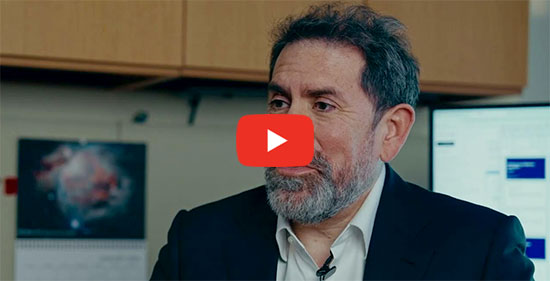
► Watch the video interview with Prof. Luis Diaz Jr.

