
Gold September: 10 years of scientific advances for children with cancer
The Gold September awareness campaign, launched in France in 2016 at the initiative of Gustave Roussy, celebrates its tenth anniversary this year. Over the past decade, the campaign has enabled numerous large-scale scientific projects to be completed by raising funds to advance the understanding and treatment of childhood cancers
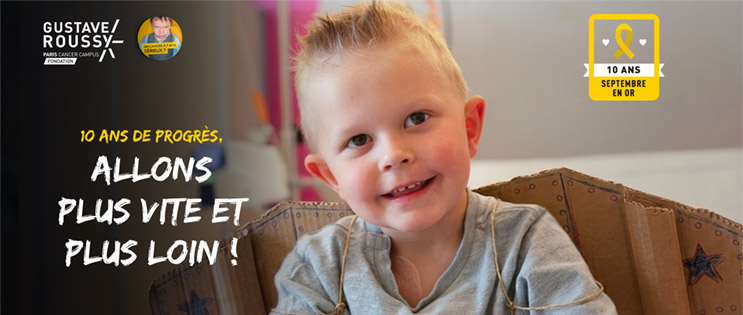
A better understanding of a childhood brain tumour, stronger long-term follow-up for survivors and access to innovative therapies for hundreds of young patients... Since 2016, the Gold September campaign and the sustained commitment of Gustave Roussy's teams have driven major advances in the treatment of cancers affecting children and adolescents.
Launched in the United States in 2012 and introduced in France four years later, Gold September brings the public together each year in the fight against childhood cancers and helps fund research. The cause remains a major challenge: every year in France, 2,300 children and adolescents are diagnosed with cancer. Although advances in research now mean that more than 80% can be cured, cancer remains the leading cause of disease-related death in children over the age of one, with nearly 500 deaths recorded each year.
These figures highlight the importance of Gold September more clearly than ever. Beyond raising public awareness, the campaign is an essential means of changing perceptions of the disease and bringing together the resources needed to achieve further medical advances. To mark the campaign's tenth anniversary in France, we look back at several research and innovation programmes made possible by this collective generosity.
The BIOMEDE programme for diffuse intrinsic pontine glioma
Diffuse intrinsic pontine gliomas (DIPG) remain the childhood tumours with the poorest prognosis. Because they are located in an area of the brain where surgery cannot be considered, there is currently no therapeutic approach capable of treating the disease. At Gustave Roussy, Dr Jacques Grill leads France's only research team dedicated to paediatric gliomas. Its work through the BIOMEDE programme has led to major advances in understanding the disease. The final results of the BIOMEDE 1.0 trial identified mutation of the TP53 gene as the main factor influencing patient survival. The trial also established everolimus combined with radiotherapy as the standard treatment for the disease and documented four patients described as long-term responders. Two further trials are already under way: BIOMEDE 2.0, which will assess the innovative therapy ONC201, and BIOMEDE AI, which uses artificial intelligence to analyse data generated since the programme began. In 2019, Dr Grill's team also identified VRK3, a protein vital to the survival of diffuse intrinsic pontine glioma tumour cells. In preclinical models, inhibiting this protein rapidly killed the cancer cells. Gustave Roussy's teams are now working to develop a treatment that blocks this protein, with the long-term aim of opening up a new therapeutic avenue for DIPG.
Demonstrating the feasibility of tumour sequencing: MAPPYACTS
Led by Gustave Roussy and coordinated by Dr Birgit Geoerger, MAPPYACTS is Europe's largest precision medicine programme for relapsed or refractory childhood cancers. Launched in 2016, MAPPYACTS 1 used high-throughput tumour sequencing to produce molecular profiles for nearly 800 children and adolescents. This first phase demonstrated the feasibility of precision medicine in paediatric oncology and identified molecular alterations that could guide patients towards targeted therapies or suitable clinical trials. Building on these results, MAPPYACTS 2 is now extending the model internationally. The study aims to enrol up to 1,800 young patients and provides a direct link between tumour sequencing, molecular tumour boards and access to innovative treatments. Its objective is to turn genomic data into concrete treatment decisions and accelerate the development of increasingly personalised medicine for children with cancer.
Safe therapeutic innovation: AcSé-ESMART
Over the past 10 years, the AcSé-ESMART programme has given more than 200 children and adolescents with 40 different types of relapsed cancer, or cancer that has not responded to treatment, access to innovative therapies. Sponsored by Gustave Roussy, it is the first early-phase clinical trial in France dedicated entirely to childhood cancers. The tumour of every patient enrolled in the trial is analysed. Depending on the molecular abnormalities detected, patients are then assigned to one of the study's 16 arms, which assess different innovative treatments, including targeted therapies and immunotherapies. The programme draws in particular on findings from projects such as MAPPYACTS, which help determine which genetic alterations may guide patients towards innovative treatments.
Therapeutic innovation from first-line treatment: Rego-Inter-Ewing-1
Multi-metastatic Ewing sarcoma remains one of the most challenging conditions in paediatric oncology, with three-year progression-free survival of around 20% when the disease has spread beyond the lungs. The Rego-Inter-Ewing-1 study, coordinated by Dr Pablo Berlanga, who presented the results at ASCO 2025, assessed for the first time the introduction of a targeted therapy from the start of treatment. Until now, innovative therapies had mainly been reserved for relapsed disease. This study has paved the way for a future European phase III trial to determine whether introducing a targeted therapy early can achieve a lasting improvement in the prognosis of these highly aggressive forms of Ewing sarcoma.
Cancer predisposition: the PREDCAP registry
Gold September has also supported the development of PREDCAP, the national registry for childhood cancer predisposition syndromes, a unique resource led by Gustave Roussy, Institut Curie and Rouen University Hospital. Bringing together more than 20 paediatric oncology centres and laboratories across France, PREDCAP collects and analyses clinical and genetic data from children with an inherited predisposition to cancer. Its aim is to improve understanding of these rare conditions, enhance genetic counselling for families, and develop more appropriate surveillance and prevention strategies.
Strengthening immunotherapy
Immunotherapy has not yet transformed the treatment of childhood cancers to the same extent as it has for some adult cancers. However, Gustave Roussy is actively contributing to its development through major international trials. In 2020, a study coordinated by Professor Véronique Minard-Colin showed that adding rituximab, a targeted immunotherapy, to chemotherapy significantly increased the likelihood of cure for children and adolescents with advanced B-cell lymphomas, mainly Burkitt lymphoma. Published in the New England Journal of Medicine, these findings led to a new international standard of care and illustrate the growing potential of immunotherapy in paediatric oncology.
Developing cell therapies for children
Cell therapies offer another promising therapeutic avenue in paediatric oncology. Among them, CAR cells, genetically modified to recognise and attack tumour cells, have already demonstrated their effectiveness in certain blood cancers. Applying them to solid tumours, however, remains a major challenge. To address this, Dr Laurie Menger and Professor Florent Ginhoux are developing CAR-iMACs, an innovative approach based on modified macrophages capable of infiltrating deep into tumours. The aim is to offer new treatment options for children with refractory or relapsed neuroblastoma, a disease for which treatment options remain limited.
Medicines finally designed for children
Innovation in paediatric oncology is not only about discovering new molecules. It is also about making treatments genuinely suitable for children. Many anticancer medicines are currently developed for adults, in formulations that can be difficult to swallow, with unsuitable doses or a taste that makes regular use difficult. To meet this need, Gustave Roussy acquired 3D-printing technologies in 2021 to produce personalised medicines, with adjusted doses, modified textures and improved acceptability for young patients, including ONC201. Dr Maxime Annereau and the pharmacy teams are now working on chewable 3D-printed formulations designed specifically for children. This approach combines personalised treatment, pharmaceutical safety and improved adherence. It also provides an innovative model of precision medicine in which a medicine is not only selected according to the tumour, but also adapted to each child's specific needs.
Long-term follow-up
Advances in medicine mean that the population of adults treated for cancer during childhood or adolescence is growing. At Gustave Roussy, people who have recovered from childhood or adolescent cancer and have been in complete remission for more than five years receive long-term clinical follow-up through the Interception personalised prevention programme. This follow-up aims to inform those concerned and to detect and treat late complications that may develop in adulthood. Care must be personalised, multidisciplinary and structured at national level, in order to develop clinical and biological research projects that identify risk factors for late complications and investigate genetic susceptibility to them.
OSTEOMAP: understanding osteosarcoma to treat it more effectively
Osteosarcoma is a rare bone cancer that mainly affects children, adolescents and young adults. In a study recently published in Nature Communications, Gustave Roussy researchers produced the most comprehensive molecular map of this cancer to date. Their work identified potential new therapeutic targets and provided a better understanding of the mechanisms involved in the development of metastases. These discoveries open up new prospects for developing more effective treatments for the most aggressive forms of the disease.