
Welcome to the new Gustave Roussy website
A new website designed to offer you a simpler, clearer, and more intuitive experience. Patients, caregivers, healthcare professionals, and donors: find information, news, and services more easily.
ASCO 2026 - An antibody–drug conjugate shows promising signs of efficacy in advanced cervical cancer
On
Changed on
ASCO 2026 – Oral abstract session
Villejuif, le 29 mai 2026
An antibody–drug conjugate shows promising signs of efficacy in advanced cervical cancer
Professor Yohann Loriot, Deputy Head of the Department of Therapeutic Innovation and Early Phase Trials (DITEP) at Gustave Roussy, presented at the ASCO congress the results of an early-phase study evaluating an antibody–drug conjugate (ADC), a new class of therapy designed to deliver chemotherapy directly to the tumour. Assessed in patients with metastatic or recurrent cervical cancer, this ADC demonstrated encouraging signs of efficacy in individuals who had already received multiple prior lines of treatment.
Abstract No. 5508 presented orally by Professor Yohann Loriot on Friday, 29th May at 16 h 57 UTC-5.
This presentation is one of 107 abstracts featured in the programme of this year's 2026 ASCO annual meeting in which Gustave Roussy's physician-researchers are taking part. The Institute is represented across a wide range of areas of expertise, reflecting both the quality of the research conducted there and its international recognition.
Globally, cervical cancer is the fourth most common cancer among women, with around 660,000 new cases diagnosed each year. As highlighted by the World Health Organization[1] (WHO), both the incidence and mortality of cervical cancer are higher in developing countries, reflecting significant inequalities in access to human papillomavirus (HPV) vaccination and to screening programmes for precancerous lesions. In France, HPV vaccination coverage, although increasing, remains insufficient. In 2023, 3,159 new cases of cervical cancer were diagnosed, and 836 deaths were recorded in 2022. These figures underscore the urgent need to develop new therapeutic approaches for this disease.
The emergence of antibody–drug conjugates
In patients with recurrent or metastatic cervical cancer, treatment options remain limited and are mainly based on chemotherapy, immunotherapy, and anti-angiogenic agents. In recent years, however, a highly promising new class of therapies has emerged in oncology: antibody–drug conjugates.
These innovative treatments act like a “guided missile”: a chemotherapy molecule is linked to an antibody, which is designed to specifically recognise and bind to a protein expressed on
the surface of cancer cells. While the mechanism of action is not yet fully understood, one of the most likely explanations is the release of chemotherapy inside tumour cells once the complex has bound to and been internalised. This targeted delivery increases treatment efficacy where it is needed while limiting its impact on surrounding healthy cells, thereby reducing the side effects often associated with conventional chemotherapy.
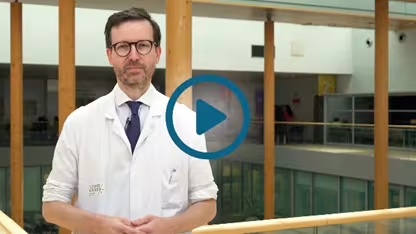
► Watch Professor Loriot’s video explanation
An antibody–drug conjugate targeting the NECTIN-4 protein
During an oral session at the ASCO congress, Professor Yohann Loriot presented the results of an international phase I/II study evaluating the ADC CRB-701, developed by Corbus Pharmaceuticals and previously shown to have promising clinical activity in head and neck cancers. This ADC targets the NECTIN-4 protein, which is expressed on the surface of many solid tumours, including 80% to 90% of cervical cancers.
A total of 72 women with advanced or recurrent cervical cancer were enrolled in the study, which aimed to identify the optimal dose of CRB-701 and evaluate its efficacy. The initial results are encouraging: at a dose of 2.7 mg/kg, more than one in five patients (22.2%) responded to treatment, administered as monotherapy. At a higher dose of 3.6 mg/kg, more than one in three patients (37.5%) benefited. In addition, complete responses were observed in several patients, meaning that all cancer lesions visible on imaging disappeared.
These findings indicate notable efficacy, particularly given that the population had been heavily pretreated. The most common side effects were mainly ocular and general (hair loss and fatigue). This work has also helped to better understand the biological mechanisms underlying the development of keratitis in some patients.
“These encouraging results suggest that CRB-701, a next-generation antibody–drug conjugate targeting the NECTIN-4 protein, could represent a promising therapeutic option for patients with recurrent or metastatic cervical cancer—a disease that still has too few treatment advances worldwide. However, these findings are preliminary, and phase III studies will be essential to confirm these results on a larger scale,” concludes Professor Yohann Loriot.
Abstract n°5508
A phase 1/2 study of the next-generation nectin-4-targeting antibody-drug conjugate CRB-701 (SYS6002) in patients with recurrent or metastatic cervical cancer.
Oral abstract session presented by Professor Yohann Loriot.
Friday, 29th May 2026 | 16 h 57 UTC-5.
pr-asco-26-antibody-drug-300526.pdf
[1] World Health Organization. (2 December 2025). Cervical cancer. https://www.who.int/fr/news-room/fact-sheets/detail/cervical-cancer
Press contact
If you are a journalist and have a question, please contact:
Claire Parisel or Léona Pinto
Tel. +33 1 42 11 50 59
Tel. +33 1 42 11 63 59
Mob. +33 6 17 66 00 26
Email
The Media Team cannot respond to patient inquiries.
Last press releases
-
ESMO 2026 - Exploring the potential of immunotherapy in early-stage triple-negative breast cancer
Dr Joana Ribeiro, medical oncologist in the Drug Development Department at Gustave Roussy, will present the results of the POP-DURVA clinical trial at the ESMO Congress. Conducted within UNLOCK, a flagship programme of the PRISM Institute, the study evaluated the addition of two immunotherapy injections before surgery in women with localised triple-negative breast cancer. With a strong translational research component, the study also investigated immunotherapy's early effects on the tumour and its immune microenvironment, to better understand the mechanisms underlying treatment response.
-
INTERCEPTION: The national pilot program for personalized cancer prevention among individuals at increased risk of cancer enters its operational phase with the enrollment of the first patients
The Interception program has reached a new milestone with the enrollment of its first patients as part of the national Article 51 pilot program. Rolled out over four years across seven healthcare facilities, this pilot program is designed to evaluate an innovative model for personalized cancer prevention and screening.

-
After a breast cancer diagnosis, how can treatment be started more quickly?
Gustave Roussy is launching a new care pathway designed to accelerate the management of women recently diagnosed with breast cancer. It brings together, in a single day, the radiology examinations, blood tests, and oncology consultation required to initiate treatment. This new pathway complements the Institute’s rapid breast care offering. The InstaDiag Breast pathway already consolidates all diagnostic examinations into a single day to establish a diagnosis.

-
Gold september: two new research programmes launched to tackle childhood cancers
Two of Gustave Roussy’s four new medical and scientific programmes are dedicated to childhood cancers. The first, DECRIPT, aims to improve understanding of the role played by genetics in the development of certain childhood cancers, as well as second cancers that may occur in adulthood. The second, INSPIRE, will draw on the knowledge and techniques already developed at the Institute to create organoids, with the aim of deciphering the mechanisms underlying metastasis and resistance to treatment.