The variety of conditions

Cancers in children and adolescents

The Department of Childhood and Adolescent Oncology focuses on the diagnosis and treatment of solid tumours and lymphomas.   

Reception of parents

Possible accommodation during the admission

Some treatments can be carried out without admitting the patient. They are then conducted on an outpatient basis, either in the Day Hospital or by a Hospital at Home arrangement. However, some treatments require conventional admission, which sometimes involves finding accommodation for the parents.  

A Paediatric ward clerk can answer your queries.
You will be informed of solutions which are suited to the patient’s situation.

The Paediatric Units

The Paediatric Department is located on the 9th floor of the main Gustave Roussy
building and is divided into various units:   

The Day Hospital: "The Village"

This is open from 8 am to 7 pm, Monday to Friday. It has a capacity of 8 places and 3 cubicles and offers ambulatory treatment rather than hospital admission.

0-12 years Unit: "The Plain"

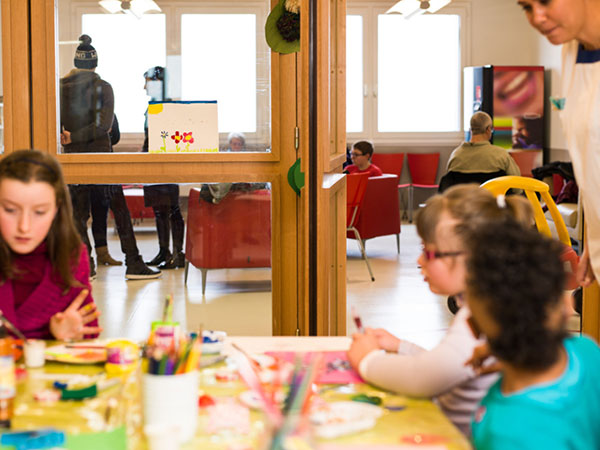
This 12-bedded unit is designed for the reception and care by specifically qualified staff of the smallest children (0 to 12 years) in an environment appropriate to the degree of independence of the child.

Ambulatory care

Ambulatory care

Depending on your doctor’s advice, many treatments can be administered without your being admitted to hospital.   

According to the medical decision, you may be looked after:

In-patient hospitalisation

Your admission

Unless you are given alternative instructions, please go to central reception as soon as you arrive in order to obtain a form which allows you to move around the hospital. The reception staff will direct you to the admissions office.       

Nutrition

Suivi diététique et nutritionnel

La pathologie tumorale, le cancer et/ou les traitements mis en œuvre peuvent perturber le statut nutritionnel et ainsi causer une dénutrition, un amaigrissement ou au contraire une surcharge pondérale. Les mécanismes de ces troubles nutritionnels sont multiples : diminution des apports, troubles digestifs en rapport avec les thérapeutiques curatives, dégoût de certains aliments...

Soins palliatifs

Soins palliatifs : généralités

Que sont les Soins Palliatifs ?

"Palliatif" vient du terme latin "palliare" qui signifie "couvrir d'un manteau, atténuer".

Les Soins Palliatifs sont des soins qui permettent d’atténuer les symptômes, les souffrances et vivre au mieux avec la maladie à défaut de pouvoir vivre sans, et parfois même plus longtemps.

Ils sont associés avec les soins oncologiques, ou non, selon les situations.

Pourquoi les Soins palliatifs ?

Avoir un manteau au cas où n’oblige pas à s’en servir et n’influera pas sur la météo.

Pages