

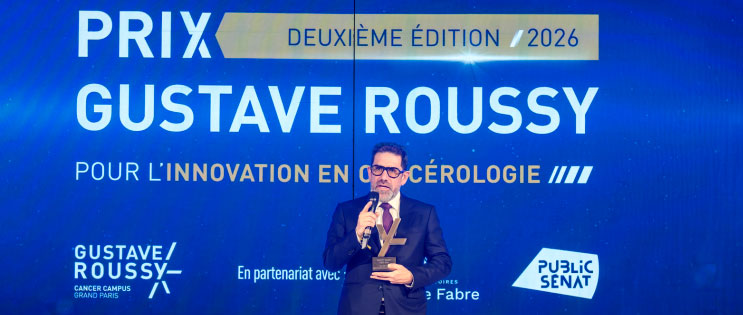
5 questions with the 2026 Gustave Roussy Prize laureate, Prof. Luis Diaz Jr.
Head of the Division of Solid Tumor Oncology in Memorial Sloan Kettering Cancer Center’s Department of Medicine, Prof. Luis Diaz Jr., MD, is an international specialist in colorectal cancers, immunotherapy, and liquid biopsy. His work, particularly on tumors with DNA instability (MSI), was unanimously recognized by the Gustave Roussy Prize jury. This work has enabled the authorization of the first-ever oncology treatment that addresses a specific biological characteristic of the disease, rather than its localization—an approach that is now central to precision medicine.
What is the central aspect of your career?
My entire career has been focused on delivering science from bench to bedside by developing concrete clinical applications to improve outcomes and challenge existing prognoses. For us as oncologists and scientists, focusing our research on the development of new drugs is essential.
Can you tell us about your main discoveries?
With my team, we have highlighted that some cancers, regardless of their location in the body, respond extremely well to immunotherapy. These tumors, described as MSI-high, are characterized by DNA instability that makes them more visible to the immune system. This breakthrough has led to significant improvements for tens of thousands of patients worldwide. MSI-high tumors represent 15% of colorectal cancers, and 3 to 5% of all advanced cancer types. We have also been pioneers in the field of liquid biopsy, an innovation that has profoundly changed the way we observe and follow cancers, through a simple blood test.
What characterizes your approach to drug development?
We have reached a point where it is now possible to act faster. Our knowledge and current technologies, especially in biomedical sciences, allow us to act differently: rather than spending an entire career on the development of one treatment to which only a small group of patients would be eligible, we are now able to develop many drugs at the same time, in a much shorter timeframe, to maximize the clinical outcomes of our discoveries.
What motivates you daily?
My work thrives on my daily exchanges with my team, but also with my patients and their families. Research in oncology doesn’t rely solely on science, nor on individual reflection towards a problem: it is teamwork. Behind every scientist, there is an entire ecosystem, a collective dynamic that motivates us every day. To see what has already been achieved, and how it radically transforms our patients’ lives, is what allows us to keep going.
What represents, to you, the Gustave Roussy prize?
To be awarded a prize is always very surprising, even more so when it is granted by an institution such as Gustave Roussy. I would like to first say that most distinctions represent collective work. If I am at this point in my career, it is because I have with me a team of researchers whose commitment and dedication have allowed us to reach such a point. Making breakthroughs in oncology is extremely challenging. The Gustave Roussy prize is an acknowledgment of not only true scientific breakthroughs but also of true medical improvements that had a concrete impact on patients with cancer. This is my greatest pride. I also hope that this prize will show the global oncology community that it is possible to achieve scientific breakthroughs for patients with cancer if we focus on shared goals and measurable results, rather than on individual credit. The feeling I have now is: how can I continue to move research forward and show that I deserve this award?
More about:
► The 2026 Edition of the Gustave Roussy Prize Awarded to Prof. Luis Diaz Jr.